Tag: math
-
Exact Hypervolume Subset Selection in 3-D: Implementing a Galactic Algorithm
Michael T. M. Emmerich, University of Jyväskylä, Finland, September 2026 In 2017 Karl Bringmann, Sergio Cabello and I showed that selecting the best out of points with respect to the hypervolume indicator is NP-hard already in three dimensions, that it can nevertheless be solved in time , and that it admits an efficient polynomial-time approximation…
-
P-adic wheels
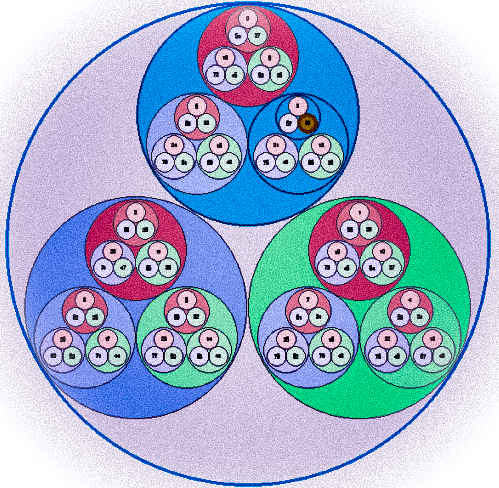
In the usual (real) number line, two numbers are “close” if their leading digits agree: is closer to than to . The p-adic world flips that intuition: closeness is governed by agreement of the low-order digits (divisibility by powers of a prime). This post introduces a small Pygame visualization (shown as circles inside circles inside…
-
A Tree-Free Path to Efficiently Compute the Hypervolume Indicator in Three Dimensions
In many algorithmic settings, the use of balanced trees, heaps, or other dynamic data structures is the standard way to achieve good asymptotic complexity. However, these structures can introduce memory fragmentation, unpredictable allocation patterns, garbage collection overhead, and branch-heavy execution — all undesirable in systems where performance must be deterministic and low-level behavior is important.…
-
Centroid Subdivision of a Triangle: A Simple Recursion Creating a Complex Pattern
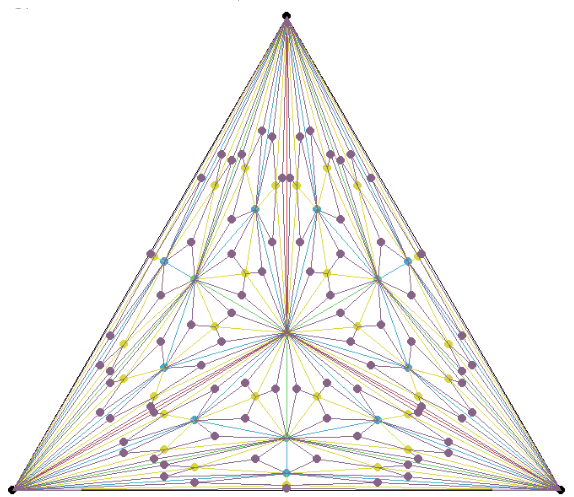
Michael Emmerich, 12 July 2025 1. Introduction A single, easily stated geometric rule—“draw the centroid of a triangle, connect it to the three vertices, and repeat recursively on the new sub-triangles”—produces a surprisingly intricate picture. This short exposition introduces the construction, shows how recursion drives the emergence of symmetry and complexity, and points out why…
-
Divisibility, Co-primes, and Euler’s Totient on the Prime Vector Grid

Michael Emmerich – 29 June 2025 1. Introduction Positive integers and their fundamental building blocks, the prime numbers, exhibit a rich combinatorial structure. This essay is part of a series that aims to derive some of the intriguing properties of integers using only elementary mathematical tools, thereby making them accessible to a broader audience. We do this…
-
Multiobjective Heatmaps: Landscape Visualization via ε-Dominance
Michael Emmerich, January 16th, 2025(inspired by a discussion of an application problem with Jonas Schwaab, ETH Zurich) In single-objective optimization, it is easy to visualize a function that depends on only two continuous or integer input variables by means of a heatmap plot, where the lightness indicates the achievement in the objective function, say F(x1,…
-
On Prime Vectors and Unique Factorization of Rationals
Michael Emmerich, January 9, 2025 In this essay, we use the theory of prime vectors (see [1]) to provide an alternative proof of the unique factorization of integers into prime factors: Unlike earlier proofs [4], notably its first proof by Carl Friedrich Gauss [3], this extends unique factorization to rational numbers, and we also establish…
-
Fundamental Theorem of Arithmetics: Zermelo’s proof in detail
The Fundamental Theorem of Arithmetic: Zermelo’s proof in detail Michael Emmerich, December 14th, 2024 Zermelo (1934) employs a proof by contradiction to establish the uniqueness of prime factorization for positive integers, demonstrating that the assumption of a non-unique prime factorization leads to a contradiction. Notably, his proof does not rely on Euclid’s Lemma. This essay…
-
Fundamental Theorem of Arithmetics: A proof from first principles
The Fundamental Theorem of Arithmetic:A Proof from Elementary Principles Michael Emmerich, December 7th, 2024 The Fundamental Theorem of Arithmetic states that every integer greater than 1 can be uniquely represented as a product of prime numbers, apart from the order of the factors. This essay aims to prove the theorem rigorously from elementary principles, i.e.,…

