Category: Mathematical Playground
-
A very, very simple method to estimate Pi
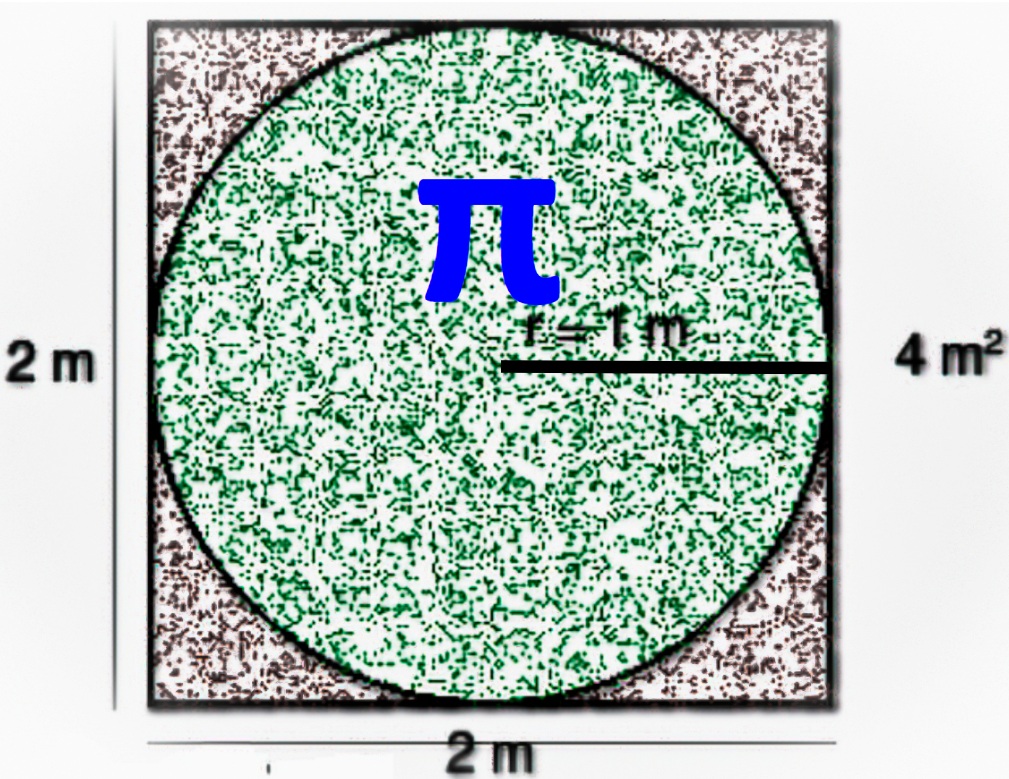
Date: 2026-03-15 Author: Michael T.M. Emmerich Every year, on March 14, mathematicians celebrate Pi Day. For my Mathematical Playground blog, I wished to post a short essay on a very, very simple Monte Carlo method for estimating . The nice aspect of this method is that it requires only a few lines of code, does…
-
Isolating Noise from Signal in the Prime Number Distribution

A Deep Dive into Riemann’s Hypothesis: Isolating Noise from Signal in the Prime Distribution Date: 2026-02-14 Author: Michael Emmerich The primes look orderly from far away and chaotic up close. At a large scale they follow clean laws: the density of primes near is about , and the prime-counting function is well approximated by .…
-
P-adic wheels
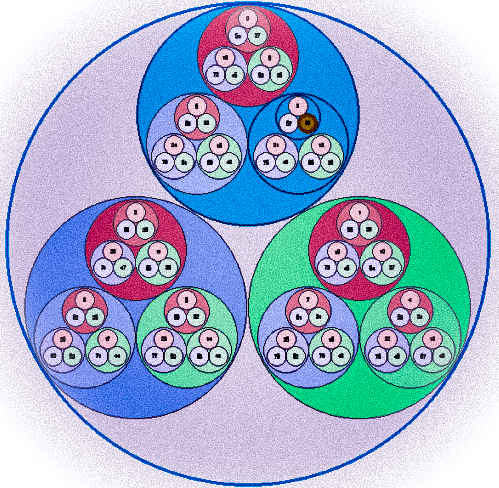
In the usual (real) number line, two numbers are “close” if their leading digits agree: is closer to than to . The p-adic world flips that intuition: closeness is governed by agreement of the low-order digits (divisibility by powers of a prime). This post introduces a small Pygame visualization (shown as circles inside circles inside…
-
How to Optimally Stack Your Books and Avoid a ‘Bad Hangover’
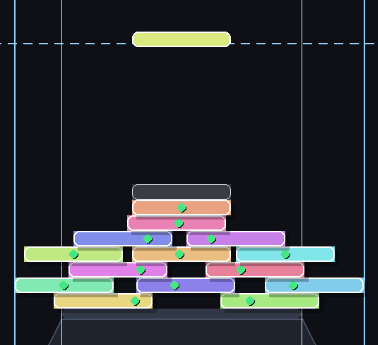
Michael T.M. Emmerich Date: 2025-12-29 Abstract It is Christmas time: books appear in cheerful piles as gifts, and in some households the morning after brings not only a “hangover” but also an ambitious attempt to stack them and exploit “overhang” beyond the edge of a table. How far can a stack of identical “books” (idealized…
-
The Hardness of Proving Hardness: Selecting Minimum Riesz Energy Subsets on a Line
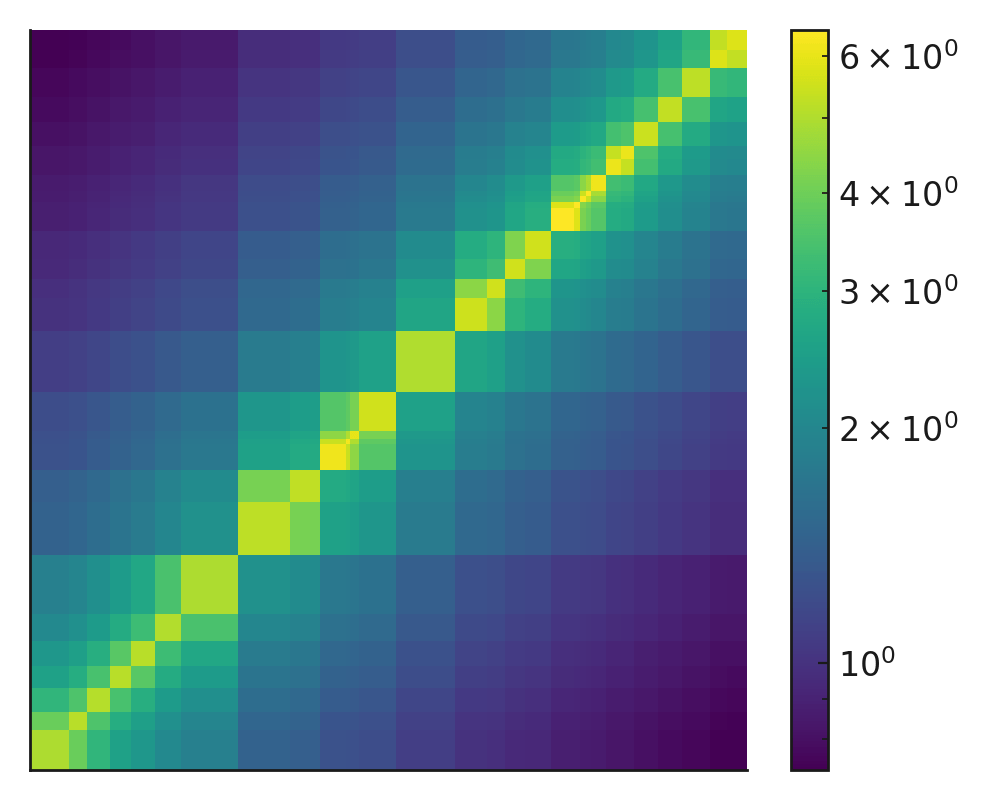
Figure: Logarithmically scaled Riesz interaction matrix for a random set of 30 points on the unit interval, with cell sizes proportional to the distances between points. Each rectangle corresponds to a pair of points: darker cells indicate stronger interactions (points that are closer on the line), while lighter cells indicate weaker interactions. Off-diagonal entries show…
-
Elegant Addition-only Prime Generation in LISP
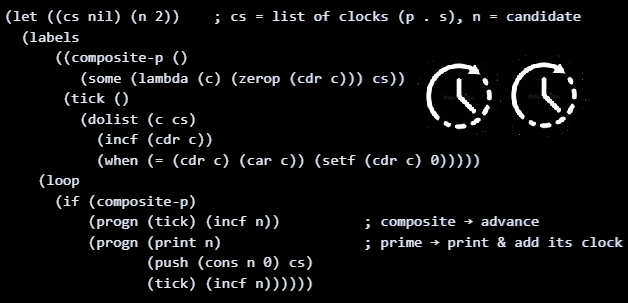
Brief history of LISP. LISP is a functional programming language that was created in the late 1950s by John McCarthy at MIT. It quickly became the lingua franca for symbolic AI because of its tiny, expressive core: homoiconic syntax (code-as-data), first-class functions/closures, macros that extend the language, and automatic memory management. McCarthy emphasized writing programs…
-
The Gumbel Distribution, Extreme Rainfall, and the Euler–Mascheroni Constant
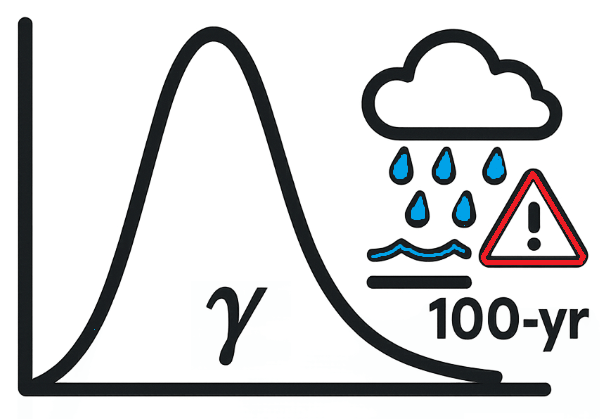
Nature doesn’t just have averages; it has extremes—the hottest day, the strongest wind, the largest daily rainfall, the highest flood. For extremes, a universal statistical law often appears: the Gumbel distribution. In this post, we meet it through a simple and realistic story about annual maximum rainfall, learn how a basic normalization makes its shape…
-
How Computers Really Work: A countdown on a von Neumann machine
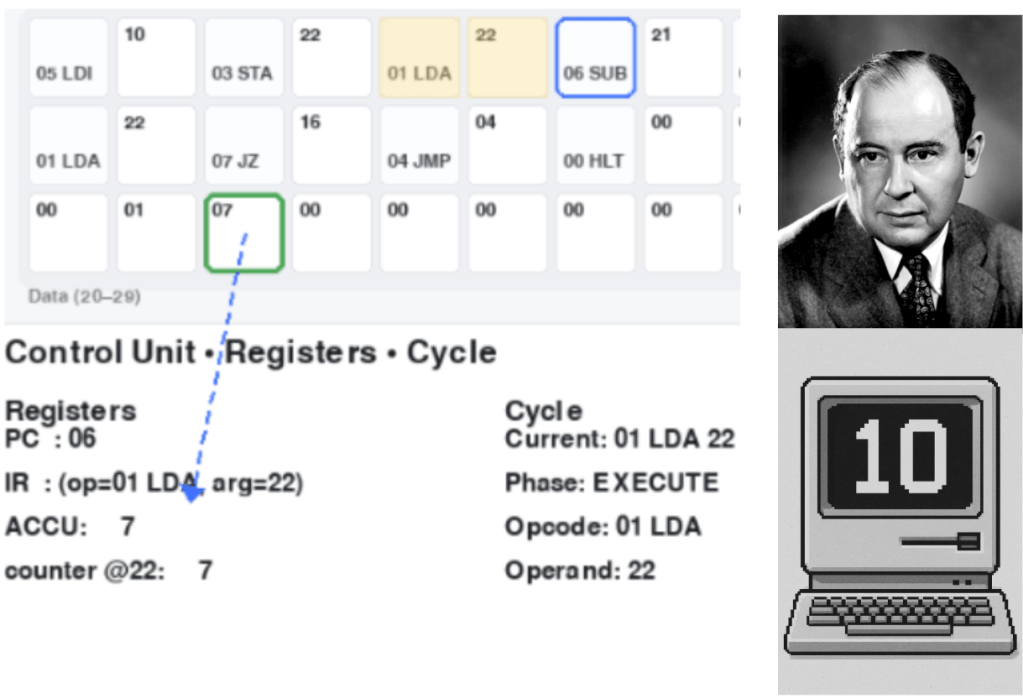
This interactive mini-simulation shows a stored-program computer in the classic von Neumann style executing a tiny machine-code program that counts down from 10 to 0. You can watch the registers and memory interact during the fetch–decode–execute cycle. It’s a compact demonstration of the model that underlies almost all modern computing—right up to the CPUs and…
-
The Tent Map – A Simple Path to Chaos
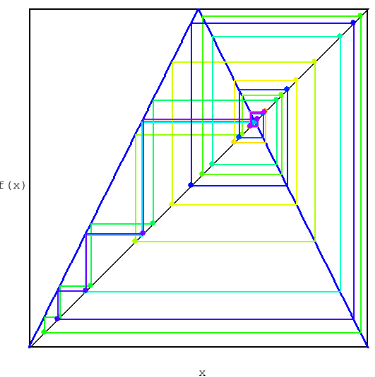
Michael Emmerich, August 20th 2025 Chaotic time series can emerge from very simple deterministic rules. The tent map is a classical example. It shows how fixed points can be unstable, how orbits diverge, and how randomness-like behavior arises from a piecewise linear rule. The Tent Map The tent map is defined on the interval by…
-
Centroid Subdivision of a Triangle: A Simple Recursion Creating a Complex Pattern
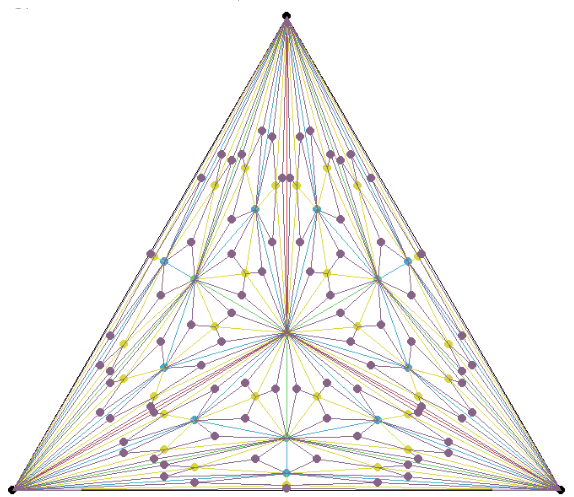
Michael Emmerich, 12 July 2025 1. Introduction A single, easily stated geometric rule—“draw the centroid of a triangle, connect it to the three vertices, and repeat recursively on the new sub-triangles”—produces a surprisingly intricate picture. This short exposition introduces the construction, shows how recursion drives the emergence of symmetry and complexity, and points out why…
 Michael Emmerich