In the usual (real) number line, two numbers are “close” if their leading digits agree:


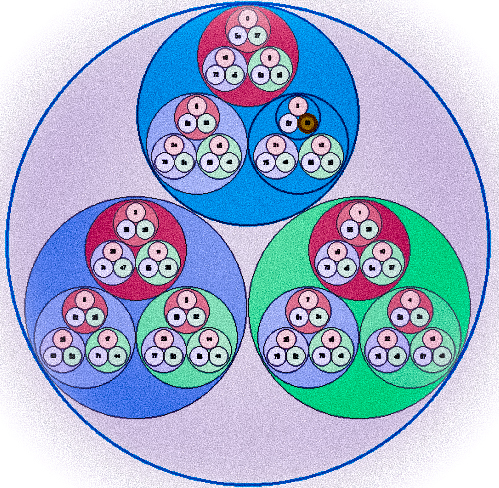
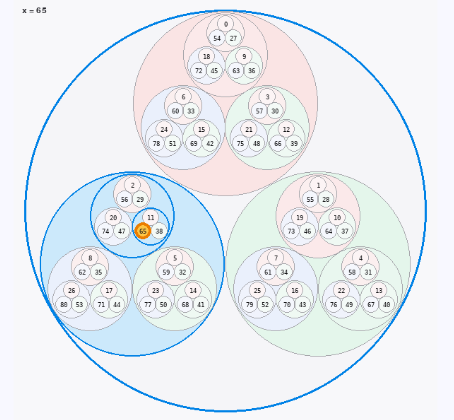
This post introduces a small Pygame visualization (shown as circles inside circles inside circles)
for the 3-adic integers 
Hensel’s “invention” of the p-adic numbers
The p-adic numbers were first systematically introduced by Kurt Hensel (1861–1941),
a German mathematician who studied in Berlin and Bonn and was strongly influenced by
Leopold Kronecker; from 1901 onward he was a professor in Marburg.
Around 1897, Hensel realized that one can build a number system by completing the rationals
not with the usual absolute value, but with a new absolute value 

A compact way to say “p-adic closeness” is: two integers 


If you’d like a classic reference from Hensel himself, see his book Zahlentheorie (1913), where p-adic methods appear in a mature, systematic form.
From congruences to nested circles
The 3-adic integers 


In the app, those balls become nested circles:
- The big circle is the whole space (schematically).
-
Inside it are 3 circles: the residue classes mod 3 (the least significant ternary digit
).
-
Inside each of those are 3 circles: refining to mod 9 (digit
).
-
Inside each of those are 3 circles: refining to mod 27 (digit
).
-
And one more layer gives mod 81 (digit
), for a total of
innermost circles labeled 0–80.
Two numbers land in the same small circle precisely when they agree modulo a high power of 3.
That’s the visual meaning of “3-adically close”: sharing deeper circles means sharing more low-order ternary digits,
i.e., 

Addition as a ternary wheel
The app animates the operation 

The nesting makes carries feel geometric. When a carry happens, the highlight doesn’t merely move to a nearby leaf; it “jumps” to a different region determined by the next digit layer. In p-adic terms, carries change higher digits, while leaving lower congruence information intact.
Here is a simple invariant you can read directly from the circles:
adding 3 does not change the residue mod 3, because 

Likewise, adding 9 does not change the residue mod 9, because 

Why this picture is helpful (and what it is not)
This is not an isometric embedding of
If you want to generalize, the same idea works for any prime 
Credits & references
- Visualization idea inspired by the illustrations of Heiko Knospe.
- K. Hensel, Zahlentheorie, 1913.
- P-adic number wheel animation: <a href=”https://trinket.io/library/trinkets/71ecc4abf5fa” Link to Interactive Python Code
 Michael Emmerich