Short, citable notes and mini-programs on
Multiobjective Optimization and Decision Analysis.
(c) by Michael T.M. Emmerich (University of Jyväskylä, Finland)
Except where otherwise noted, content on this site is licensed under a
Creative Commons Attribution 4.0 International License
.


- What Combinatorial Chemistry can Teach us about the AI revolution in Mathematics and Informatics
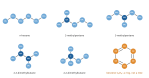 Michael T. M. Emmerich, University of Jyväskylä, Finland, September 2026 Chemistry has been an application field of mine for many years, including work on multi-objective optimisation and artificial intelligence in drug design [LMEW2023]. This is one reason why the present discussion about AI in mathematics and informatics feels familiar to me. Drug discovery has already… Read more: What Combinatorial Chemistry can Teach us about the AI revolution in Mathematics and Informatics
 - Exact Hypervolume Subset Selection in 3-D: Implementing a Galactic AlgorithmMichael T. M. Emmerich, University of Jyväskylä, Finland, September 2026 In 2017 Karl Bringmann, Sergio Cabello and I showed that selecting the best out of points with respect to the hypervolume indicator is NP-hard already in three dimensions, that it can nevertheless be solved in time , and that it admits an efficient polynomial-time approximation… Read more: Exact Hypervolume Subset Selection in 3-D: Implementing a Galactic Algorithm
- The Unit Distance Problem: Erdős’s Lattices, AI-Aided Breakthrough, and Community-Optimized Solutions
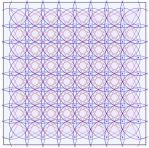 Date: June 2026 Author: Michael T. M. Emmerich This report is about the unit disc problem, a problem that was receiving recently renewed attention because AI tools [OpenAI2026] helped to disprove a long open conjecture on this problem. We will discuss the problem and the geometrical conjecture, and how the main idea of how it… Read more: The Unit Distance Problem: Erdős’s Lattices, AI-Aided Breakthrough, and Community-Optimized Solutions
 - When Diversity Becomes Logic
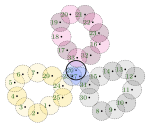 How selecting diverse subsets can encode logical circuits Michael Emmerich, May 12th 2026. Figure 1 shows how the satisfiability of the 3-SAT clause (‘1’ OR ‘2’ OR ‘3’) can be encoded as a maximum-diversity subset selection problem. Each disc centre represents a candidate choice, and the task is to select as many non-overlapping discs as… Read more: When Diversity Becomes Logic
 - Diversity Subset Selection on Lines and Staircases
 My report, titled Exact Dynamic Programming for Solow–Polasky Diversity Subset Selection on Lines and Staircases, is now available on arXiv: https://arxiv.org/abs/2604.26929. In multiobjective optimization and decision analysis, we often face a deceptively simple task: from a larger set of candidate solutions, choose a smaller subset that is still representative, well-spread, and diverse. This sounds easy… Read more: Diversity Subset Selection on Lines and Staircases
 - Clarke Cone Ascent via Nonsmooth Paths to Pareto Fronts of Maximum Magnitude
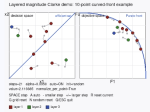 Optimization is often introduced through smooth landscapes and ordinary gradients. In multiobjective optimization, however, the geometry of a finite approximation set can change abruptly: points can switch nondomination status, layers can appear or disappear, and different points can suddenly become active in shaping the dominated region. At such events, the objective is no longer classically… Read more: Clarke Cone Ascent via Nonsmooth Paths to Pareto Fronts of Maximum Magnitude
 - Interval Filters for Pre-Selection in Model-Assisted Constrained Pareto Optimization
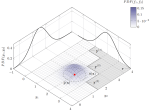 Michael Emmerich, JYU, Finland, 28.1.2026 When objective and constraint evaluations are expensive (CFD/FEM, digital-twin simulations, etc.), we often rely on Gaussian process regression (Kriging) as a surrogate. A GP does not only predict a mean vector, it also delivers uncertainty. Interpreted component-wise, this uncertainty naturally forms an axis-aligned confidence box in for objectives (and similarly… Read more: Interval Filters for Pre-Selection in Model-Assisted Constrained Pareto Optimization
 - How to Optimally Stack Your Books and Avoid a ‘Bad Hangover’
 Michael T.M. Emmerich Date: 2025-12-29 Abstract It is Christmas time: books appear in cheerful piles as gifts, and in some households the morning after brings not only a “hangover” but also an ambitious attempt to stack them and exploit “overhang” beyond the edge of a table. How far can a stack of identical “books” (idealized… Read more: How to Optimally Stack Your Books and Avoid a ‘Bad Hangover’
 - Knee-Deep in the Mud and Climbing Out with a Clean FaceA History-Aware Multiobjective View of Escalation and De-escalation of Commitment We usually expect people to change course after negative feedback. Yet in investment and project settings the opposite is common: decision makers sometimes increase their commitment to a failing course of action. This pattern is known as escalation of commitment (Staw 1976; Staw 1981; Brockner… Read more: Knee-Deep in the Mud and Climbing Out with a Clean Face
- The Hardness of Proving Hardness: Selecting Minimum Riesz Energy Subsets on a Line
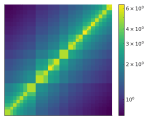 Figure: Logarithmically scaled Riesz interaction matrix for a random set of 30 points on the unit interval, with cell sizes proportional to the distances between points. Each rectangle corresponds to a pair of points: darker cells indicate stronger interactions (points that are closer on the line), while lighter cells indicate weaker interactions. Off-diagonal entries show… Read more: The Hardness of Proving Hardness: Selecting Minimum Riesz Energy Subsets on a Line
 - A Visualizer for 3-D Pareto Fronts Based on Anchored Boxes
- A Tree-Free Path to Efficiently Compute the Hypervolume Indicator in Three DimensionsIn many algorithmic settings, the use of balanced trees, heaps, or other dynamic data structures is the standard way to achieve good asymptotic complexity. However, these structures can introduce memory fragmentation, unpredictable allocation patterns, garbage collection overhead, and branch-heavy execution — all undesirable in systems where performance must be deterministic and low-level behavior is important.… Read more: A Tree-Free Path to Efficiently Compute the Hypervolume Indicator in Three Dimensions
- Multiobjective Heatmaps: Landscape Visualization via ε-DominanceMichael Emmerich, January 16th, 2025(inspired by a discussion of an application problem with Jonas Schwaab, ETH Zurich) In single-objective optimization, it is easy to visualize a function that depends on only two continuous or integer input variables by means of a heatmap plot, where the lightness indicates the achievement in the objective function, say F(x1,… Read more: Multiobjective Heatmaps: Landscape Visualization via ε-Dominance
- 2-D Hypervolume Subset Selection in PythonHypervolume Subset Selection Problem (HSSP) is a dynamic programming algorithm used to select a subset of points from a non-dominated 2D Pareto front. This subset maximizes the hypervolume (or dominated area in 2-D) covered with respect to a reference point that bounds this area from above to make it finite. Originally proposed by Auger et… Read more: 2-D Hypervolume Subset Selection in Python
- Uniformly Lighting the Christmas Tree: Riesz s-Energy in ActionUniformly Lighting the Christmas Trees: Riesz -Energy in Action Michael Emmerich, December 25th, 2024 Did you ever have the problem of how to distribute candles uniformly across your Christmas Tree? Well, here is a solution from the mathematical sciences! Using the concept of Riesz -Energy, we can optimize the placement of stars or candles on… Read more: Uniformly Lighting the Christmas Tree: Riesz s-Energy in Action

