Category: Prime Numbers
-
Elegant Addition-only Prime Generation in LISP
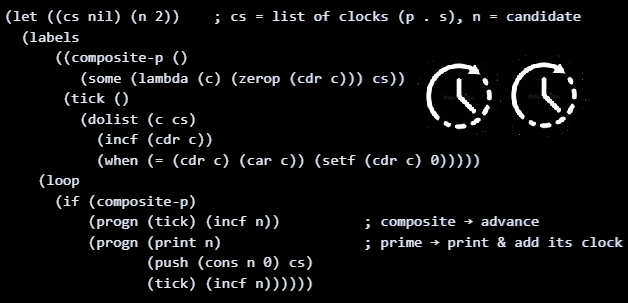
Brief history of LISP. LISP is a functional programming language that was created in the late 1950s by John McCarthy at MIT. It quickly became the lingua franca for symbolic AI because of its tiny, expressive core: homoiconic syntax (code-as-data), first-class functions/closures, macros that extend the language, and automatic memory management. McCarthy emphasized writing programs…
-
The Tent Map – A Simple Path to Chaos
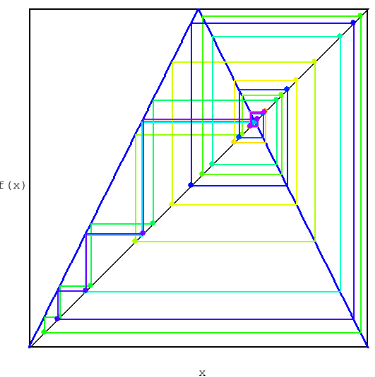
Michael Emmerich, August 20th 2025 Chaotic time series can emerge from very simple deterministic rules. The tent map is a classical example. It shows how fixed points can be unstable, how orbits diverge, and how randomness-like behavior arises from a piecewise linear rule. The Tent Map The tent map is defined on the interval by…
-
Divisibility, Co-primes, and Euler’s Totient on the Prime Vector Grid

Michael Emmerich – 29 June 2025 1. Introduction Positive integers and their fundamental building blocks, the prime numbers, exhibit a rich combinatorial structure. This essay is part of a series that aims to derive some of the intriguing properties of integers using only elementary mathematical tools, thereby making them accessible to a broader audience. We do this…
-
On Prime Vectors and Unique Factorization of Rationals
Michael Emmerich, January 9, 2025 In this essay, we use the theory of prime vectors (see [1]) to provide an alternative proof of the unique factorization of integers into prime factors: Unlike earlier proofs [4], notably its first proof by Carl Friedrich Gauss [3], this extends unique factorization to rational numbers, and we also establish…
-
Fundamental Theorem of Arithmetics: Zermelo’s proof in detail
The Fundamental Theorem of Arithmetic: Zermelo’s proof in detail Michael Emmerich, December 14th, 2024 Zermelo (1934) employs a proof by contradiction to establish the uniqueness of prime factorization for positive integers, demonstrating that the assumption of a non-unique prime factorization leads to a contradiction. Notably, his proof does not rely on Euclid’s Lemma. This essay…
-
Fundamental Theorem of Arithmetics: A proof from first principles
The Fundamental Theorem of Arithmetic:A Proof from Elementary Principles Michael Emmerich, December 7th, 2024 The Fundamental Theorem of Arithmetic states that every integer greater than 1 can be uniquely represented as a product of prime numbers, apart from the order of the factors. This essay aims to prove the theorem rigorously from elementary principles, i.e.,…
-
Triangularized: Sierpinski’s Gasket and Pascal’s Triangle
Triangularized: Sierpinski’s Gasket and Pascal’s Triangle Michael Emmerich, September 28th. 2024 Introduction The Sierpinski Gasket is a fractal pattern named after the Polish mathematician Wacław Sierpiński (1882–1969). Sierpiński was a prominent figure in set theory, number theory, and topology, and he introduced several well-known fractals, including the Sierpinski Gasket (also known as the Sierpinski Triangle)…
-
Grand Cycles of the Primes
On Periodic Patterns in the Prime Clockwork – September 15th, 2024, Michael Emmerich I have two rotating gears, with 90 and 54 teeth. When do the starting points of these gears align? — Wilson, R. (2020). Number Theory: A Very Short Introduction. Oxford University Press, Page 7 When do the gears align again? The textbook…
 Michael Emmerich