Category: Mathematical Playground
-
Divisibility, Co-primes, and Euler’s Totient on the Prime Vector Grid

Michael Emmerich – 29 June 2025 1. Introduction Positive integers and their fundamental building blocks, the prime numbers, exhibit a rich combinatorial structure. This essay is part of a series that aims to derive some of the intriguing properties of integers using only elementary mathematical tools, thereby making them accessible to a broader audience. We do this…
-
Überlichtschnelle Quantenkommunikation? – Zwischen Einsteins Hypothese und Bells Experiment (in German)
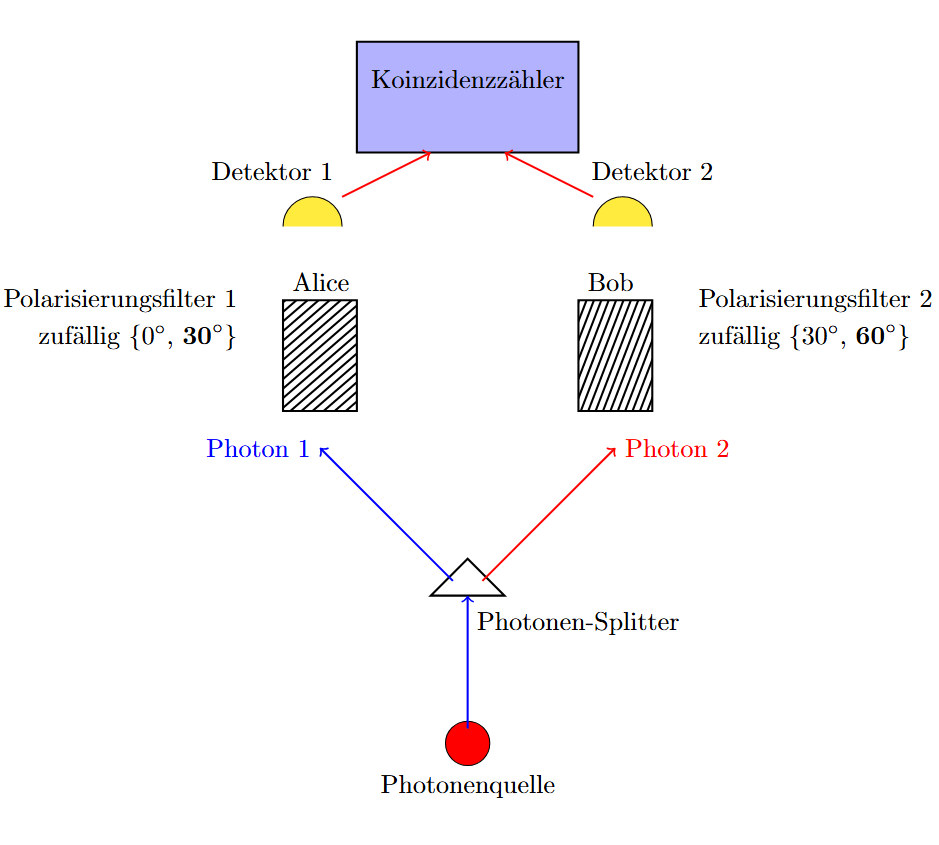
In diesem Beitrag versuche ich, auf einfache Weise darzustellen, wie mithilfe der Wahrscheinlichkeitsrechnung in einem Experiment festgestellt werden kann, ob ein System verborgene Variablen besitzt. Diese Methode ist von herausragender Bedeutung, da sie den statistischen Nachweis erbringt, dass Quantenkommunikation quasi instantan – also schneller als Lichtgeschwindigkeit – ablaufen kann. Gleichzeitig werden zentrale Prinzipien der Quantenmechanik…
-
On Prime Vectors and Unique Factorization of Rationals
Michael Emmerich, January 9, 2025 In this essay, we use the theory of prime vectors (see [1]) to provide an alternative proof of the unique factorization of integers into prime factors: Unlike earlier proofs [4], notably its first proof by Carl Friedrich Gauss [3], this extends unique factorization to rational numbers, and we also establish…
-
Uniformly Lighting the Christmas Tree: Riesz s-Energy in Action
Uniformly Lighting the Christmas Trees: Riesz -Energy in Action Michael Emmerich, December 25th, 2024 Did you ever have the problem of how to distribute candles uniformly across your Christmas Tree? Well, here is a solution from the mathematical sciences! Using the concept of Riesz -Energy, we can optimize the placement of stars or candles on…
-
Fundamental Theorem of Arithmetics: Zermelo’s proof in detail
The Fundamental Theorem of Arithmetic: Zermelo’s proof in detail Michael Emmerich, December 14th, 2024 Zermelo (1934) employs a proof by contradiction to establish the uniqueness of prime factorization for positive integers, demonstrating that the assumption of a non-unique prime factorization leads to a contradiction. Notably, his proof does not rely on Euclid’s Lemma. This essay…
-
Fundamental Theorem of Arithmetics: A proof from first principles
The Fundamental Theorem of Arithmetic:A Proof from Elementary Principles Michael Emmerich, December 7th, 2024 The Fundamental Theorem of Arithmetic states that every integer greater than 1 can be uniquely represented as a product of prime numbers, apart from the order of the factors. This essay aims to prove the theorem rigorously from elementary principles, i.e.,…
-
The Partition Problem and the Possibility of an U.S. Electoral Stalemate
The Partition Problem and the Possibility of an U.S. Electoral Stalemate Michael Emmerich, November 4th 2024 1. Integer Partitionings This essay is about an interesting problem in computational mathematics, and its solution with integer linear programming. A didactic example is provided, that could motivate the problem and is closely related to the U.S. presidential election…
-
RSA Cryptography: Alice and Bob
Bob and Alice sending each other messages (AI generated picture) Imagine trying to piece together a jigsaw puzzle with thousands of scattered pieces. It’s easy to make a mess, but nearly impossible to reassemble without knowing the original pattern. This is the core of a one-way function: simple to compute in one direction, but fiendishly…
-
Of Autumn Leaves and Coupon Collectors
Essay by Michael Emmerich, October 11th, 2024 Imagine a peaceful autumn day where leaves gently fall, covering a patch of land. The land can be represented as a grid or matrix with distinct places, each starting uncovered. As the leaves fall, they randomly land on one of these places, gradually covering the ground. But how…
-
Triangularized: Sierpinski’s Gasket and Pascal’s Triangle
Triangularized: Sierpinski’s Gasket and Pascal’s Triangle Michael Emmerich, September 28th. 2024 Introduction The Sierpinski Gasket is a fractal pattern named after the Polish mathematician Wacław Sierpiński (1882–1969). Sierpiński was a prominent figure in set theory, number theory, and topology, and he introduced several well-known fractals, including the Sierpinski Gasket (also known as the Sierpinski Triangle)…
 Michael Emmerich