Michael Emmerich, Jyväskylä, 8.8.2026
Goldbach’s conjecture says that every even integer greater than 2 is a sum of two primes. It is either true or false; there is no literal probability attached to its truth value. So what could it mean to say that the conjecture is “likely” to be true?
A useful interpretation is this: if we compare the prime numbers with random or pseudorandom sets having similar density, how exceptional would a failure of the two-sum property be? From this point of view the evidence is that random sets much sparser than the primes already tend to represent every sufficiently large even integer as a sum of two selected elements and the probability that one would find a integer that cannot be expressed as a two-sum tends to zero.
The primes therefore do not appear to be barely numerous enough. Their density lies far above the natural random threshold, and the usual Hardy–Littlewood heuristic predicts not one precarious representation of a large even integer 

The real question is therefore different. Can the deterministic arithmetic structure of the primes produce an exceptional even integer for which all of these possible representations (pairs) fail simultaneously? The argument below separates these two issues. Abundance is easy to explain probabilistically; ruling out a perfectly coordinated arithmetic failure is the difficult part.
Armstrong (2020) pointed out that the Goldbach conjecture is ‘probably’ true and used some random model of integers. We follow this idea albeit our model of the integer is slightly different and uses the theory of additive bases and Chernoff bounds. We provide next to the blog-post a PDF with detailed derivations and didactic appendices (link provided at the end of this document).
A simple random model
Consider only odd positive integers. Include each odd integer 


For an even integer 

For fixed 


The probability that no pair is selected satisfies

If 

Borel–Cantelli Lemma and Chernoff Bounds in plain terms
The first Borel–Cantelli lemma is a bookkeeping principle for rare failures. If 

then with probability 1 only finitely many of the events
A Chernoff bound expresses a different idea. If 


Thus Chernoff bounds say that large independent sums stay close to their expected size, while Borel–Cantelli says that a summable sequence of exceptional probabilities can produce only finitely many exceptions almost surely. Readable introductions are given in [8] and [9].
The critical density
Near a large integer 


The transition relevant to eventual coverage occurs when

Thus the natural critical density is

This scale is classical in the theory of random additive bases [1,2]. The point here is not a new threshold theorem, but the comparison with the primes.
In the odd-integer model 

Prime density is much larger
Among odd integers near

Compared with the critical random scale,

At prime-like density the expected number of representations of a large even integer is of order

which is much larger than the logarithmic representation count near the threshold.
A three-way numerical comparison
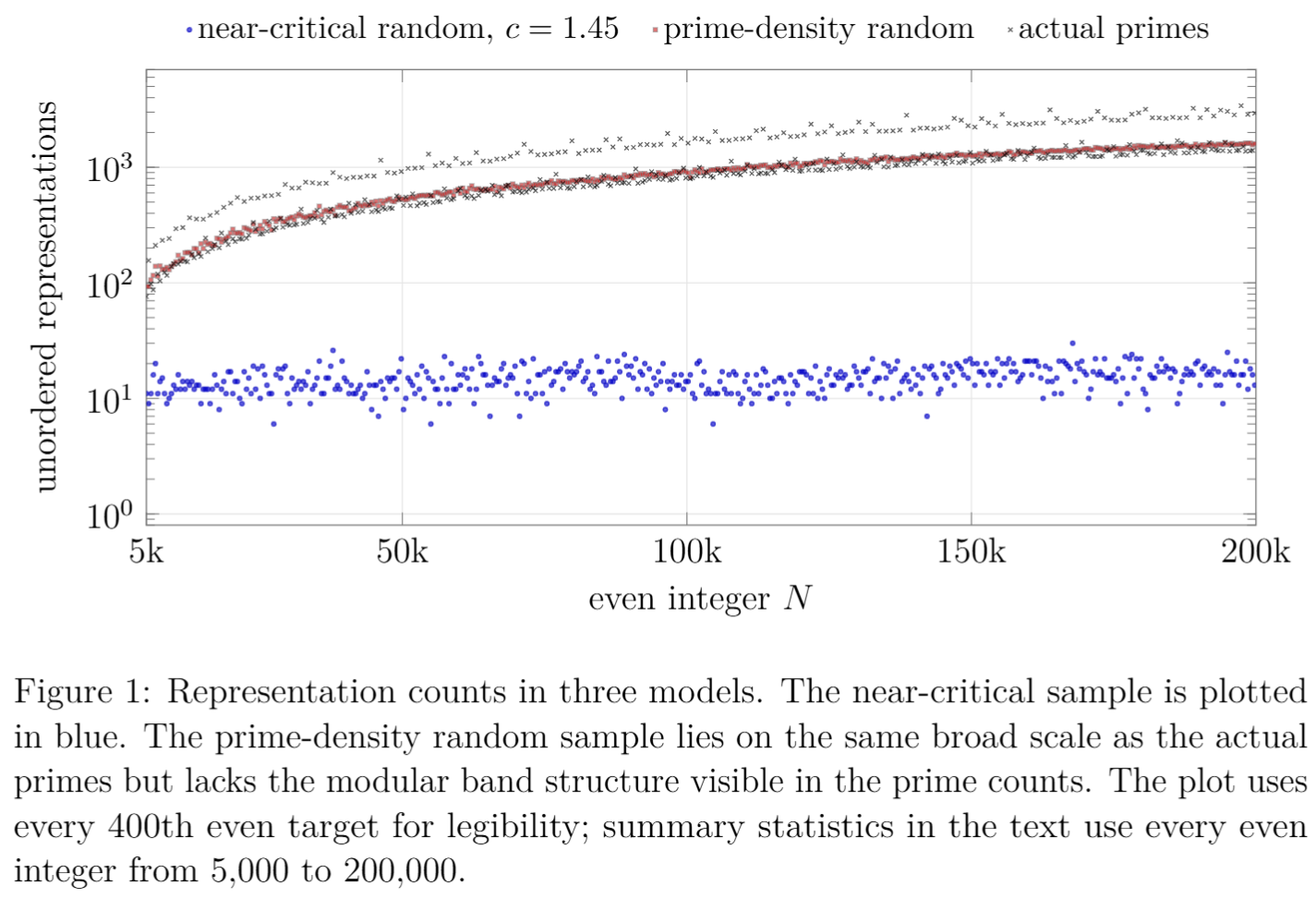
The experiment compares three point sets on the same logarithmic scale:
- one near-critical random set with
;
- one independent prime-density random set with
;
- the actual primes.
The blue points are one actual near-critical realization. The second random realization has prime-like density and therefore many more representations. The actual primes lie on the same broad abundance scale as the prime-density random model, but show a clear arithmetic band structure.
For the near-critical model, 98.5% of 400 independent samples represented every even integer from 5,000 through 200,000. This is a finite-range numerical experiment, not an asymptotic proof.
- near-critical random set: median 15, mean 14.8, minimum 1;
- prime-density random set: median 928, mean 912.8, minimum 77;
- actual primes: median 814, mean 908.2, minimum 50.
Why the prime counts form bands
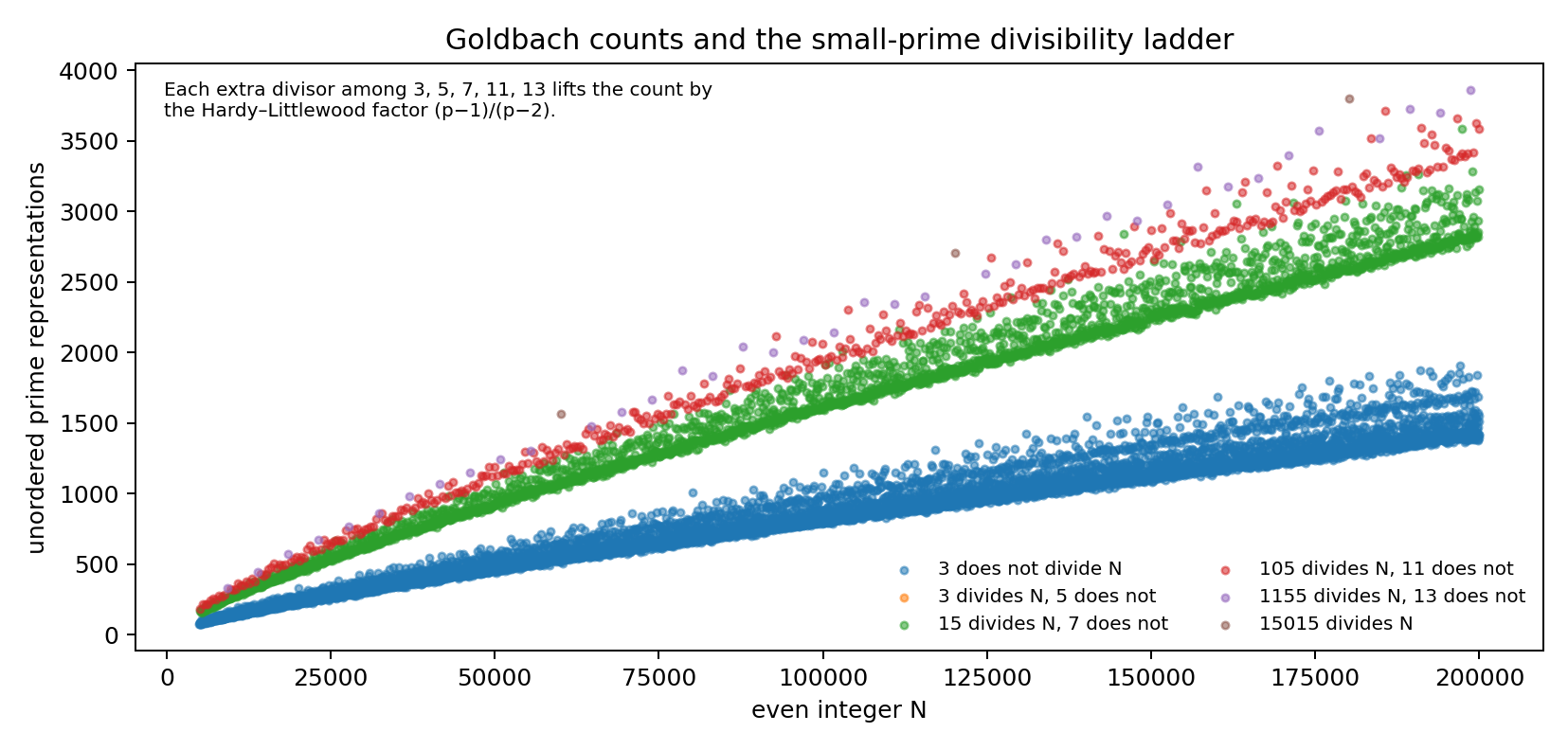
The two dominant bands in the prime data are mainly a congruence effect modulo 3. The Hardy–Littlewood heuristic predicts a representation count containing the arithmetic factor

If 


Thus even integers divisible by 3 are expected, other things being comparable, to have roughly twice as many prime representations as nearby even integers not divisible by 3. Divisibility by 5, 7, and other small primes creates finer splittings inside the main bands.
The prime-density random sample has approximately the same abundance as the primes, but it does not know about divisibility by 3, 5, 7, and so on. Its point cloud is therefore much more homogeneous. Density explains the broad scale; arithmetic correlations explain the fine structure.
A much sparser subset of the primes
There is a useful deterministic comparison which shows that even full prime density is not necessary for strong additive behavior.
Consider the primes which can be written in the form

Iwaniec’s work on primes represented by quadratic forms implies that the number of such primes up to 

Since the total number of primes up to 

inside the primes. Thus it is genuinely sparse even when measured relative to the primes themselves.
Nevertheless, Teräväinen proved that almost every even integer satisfying the necessary local congruence conditions is a sum of two primes of the form 
This example sharpens the point of the density comparison. A set can have zero relative density inside the primes and still display very strong additive coverage, provided it is sufficiently well distributed and the local obstructions are respected.
There is also a useful comparison with the random threshold which we will name the counting scale

is still much larger than the critical random counting scale

because

Thus Teräväinen’s set is sparse relative to the primes, but it is not close to the random additive-basis threshold. The lesson is more subtle: density provides room for representations, while local arithmetic distribution determines whether that room can actually be used.
Why does this not prove Goldbach’s conjecture?
The primes are not independent random variables. They form one fixed deterministic sequence. A counterexample to Goldbach’s conjecture would require that, for some even 

Informally, the primes would have to “conspire” so that all potential pairs fail at the same target. This is not a shortage-of-primes phenomenon. It is a statement about correlations.
A large prime gap by itself is not enough. One gap removes only a local collection of candidate pairs. A Goldbach counterexample requires the global reflected avoidance condition

for every relevant prime 
Density alone is also insufficient for deterministic subsets of the primes. Alsetri and Shao show that suitable local density hypotheses give an almost-all binary Goldbach theorem, while high global density alone can still fail badly [4]. Abundance and additive structure are different matters.
A logical asymmetry
Goldbach’s conjecture is a universal assertion whose individual cases are finitely decidable. If it is false, there is a definite even integer 
If the conjecture is true, there is no last integer to check. A proof has to control all even integers at once. In principle a true universal arithmetic statement can even be unprovable in a chosen formal theory, although there is no evidence that this is what happens for Goldbach’s conjecture.
Could the reason simply be statistical?
There need not be a simple distinguished mechanism assigning a special prime pair to every even integer. It is conceivable that Goldbach’s conjecture is true for a more diffuse reason that after the necessary congruence restrictions are taken into account, the primes may be sufficiently dense and sufficiently pseudorandom that the many possible representations never all disappear at once.
In that sense the truth could be statistical in character. At prime density one expects on the order of

candidate representations. A failure would require the arithmetic correlations of the primes to suppress all of them simultaneously.
But a statistical-looking reason for truth does not imply that there is no finite proof. A finite proof need not identify a canonical representation of each 
Thus one should keep two questions separate:

Unprovability is a different, theory-relative possibility. Goldbach’s conjecture could in principle be true but unprovable in a specified formal system such as Peano arithmetic. That possibility comes from mathematical logic, not from the apparent randomness of the primes. There is presently no evidence that Goldbach’s conjecture is independent of the usual formal systems.
The contrast in this theory is nevertheless somwhat interesting and puzzling. The truth may be in some sense statistical in character, while any proof must be deterministic.
Python source for the experiment
The following is the complete source used for the three-way simulation.
import numpy as np
import matplotlib.pyplot as plt

NMAX = 200_000
NMIN = 5_000
C = 1.45
NSAMPLES = 400
SEED = 20260808
FIGURE = "goldbach_threeway_simulation_v13.png"

def sieve(n):
    p = np.ones(n + 1, dtype=bool)
    p[:2] = False
    p[4::2] = False
    for k in range(3, int(n**0.5) + 1, 2):
        if p[k]:
            p[k*k::2*k] = False
    return p

def two_sum_counts(a):
    """Unordered counts N=x+y with x<y and x,y selected."""
    n = len(a)
    size = 1 << (2*n - 1).bit_length()
    f = np.fft.rfft(a.astype(float), size)
    conv = np.rint(np.fft.irfft(f*f, size)[:2*n-1]).astype(np.int64)

    N = np.arange(len(conv))
    diag = np.zeros_like(conv)
    even = (N % 2 == 0)
    half = N[even] // 2
    ok = half < n
    diag[np.flatnonzero(even)[ok]] = a[half[ok]]
    return (conv - diag) // 2

n = np.arange(NMAX + 1)
odd = (n >= 3) & (n % 2 == 1)
rng = np.random.default_rng(SEED)

# 1. Actual odd primes.
prime = sieve(NMAX)
prime[2] = False
prime_counts = two_sum_counts(prime)[:NMAX + 1]

# 2. Near-critical random set:
# q_n = c sqrt(log n / n), c > 2/sqrt(pi).
q_critical = np.zeros(NMAX + 1)
q_critical[odd] = np.minimum(
    1.0, C*np.sqrt(np.log(n[odd])/n[odd])
)
critical_sample = rng.random(NMAX + 1) < q_critical
critical_sample[~odd] = False
critical_counts = two_sum_counts(critical_sample)[:NMAX + 1]

# 3. Prime-density random set:
# q_n = 2/log n among odd integers.
q_prime_like = np.zeros(NMAX + 1)
q_prime_like[odd] = np.minimum(1.0, 2.0/np.log(n[odd]))
prime_like_sample = rng.random(NMAX + 1) < q_prime_like
prime_like_sample[~odd] = False
prime_like_counts = two_sum_counts(prime_like_sample)[:NMAX + 1]

# Repeated near-critical realizations estimate finite-range coverage.
targets = np.arange(NMIN, NMAX + 1, 2)
covered = 0
for _ in range(NSAMPLES):
    a = rng.random(NMAX + 1) < q_critical
    a[~odd] = False
    counts = two_sum_counts(a)[:NMAX + 1]
    covered += np.all(counts[targets] > 0)

coverage = covered / NSAMPLES
print(f"Near-critical coverage on [{NMIN}, {NMAX}]: {coverage:.3f}")

for label, counts in [
    ("near-critical random", critical_counts),
    ("prime-density random", prime_like_counts),
    ("actual primes", prime_counts),
]:
    vals = counts[targets]
    print(
        f"{label:20s}: median={np.median(vals):.1f}, "
        f"mean={np.mean(vals):.1f}, min={np.min(vals)}"
    )

# Thin the plotted points for a compact blog figure.
x = np.arange(NMIN, NMAX + 1, 200)

fig, ax = plt.subplots(figsize=(9, 3.25))
ax.scatter(
    x, critical_counts[x], s=11, color="blue", alpha=0.62,
    label=f"near-critical random, c={C}"
)
ax.scatter(
    x, prime_like_counts[x], s=11, marker="s", alpha=0.52,
    label="prime-density random"
)
ax.scatter(
    x, prime_counts[x], s=12, marker="x", alpha=0.55,
    label="actual primes"
)
ax.set_yscale("log")
ax.set_xlabel("even integer N")
ax.set_ylabel("unordered representations")
ax.set_title("Two-sum representations: threshold, prime density, primes")
ax.legend(frameon=False, fontsize=8, ncol=3)
ax.text(
    0.02, 0.04,
    f"Near-critical Monte Carlo: {coverage:.1%} of {NSAMPLES} samples cover "
    f"every even N in [{NMIN:,}, {NMAX:,}]",
    transform=ax.transAxes, fontsize=8
)
fig.tight_layout()
fig.savefig(FIGURE, dpi=180)
plt.close(fig)
References
- S. Armstrong, “The Goldbach conjecture is probably correct; so was Fermat’s last theorem,” LessWrong, 14 July 2020.
- P. Erdős, “On a problem of Sidon in additive number theory,” Acta Scientiarum Mathematicarum (Szeged) 15 (1954), 255–259.
- P. Erdős and A. Rényi, “Additive properties of random sequences of positive integers,” Acta Arithmetica 6 (1960), 83–110.
- G. H. Hardy and J. E. Littlewood, “Some problems of Partitio Numerorum III: On the expression of a number as a sum of primes,” Acta Mathematica 44 (1923), 1–70.
- A. Alsetri and X. Shao, “Density versions of the binary Goldbach problem,” Acta Arithmetica 218 (2025), 285–295.
- H. Iwaniec, “Primes of the type φ(x,y)+A where φ is a quadratic form,” Acta Arithmetica 21 (1972), 203–234. DOI: 10.4064/aa-21-1-203-234.
- J. Teräväinen, “The Goldbach problem for primes that are sums of two squares plus one,” Mathematika 64 (2018), 20–70. DOI: 10.1112/S0025579317000341.
- T. Oliveira e Silva, S. Herzog, and S. Pardi, “Empirical verification of the even Goldbach conjecture and computation of prime gaps up to
,” Mathematics of Computation 83 (2014), 2033–2060.
- M. Mitzenmacher and E. Upfal, Probability and Computing, 2nd ed., Cambridge University Press, 2017, Chapter 4.
- G. R. Grimmett and D. R. Stirzaker, Probability and Random Processes, 3rd ed., Oxford University Press, 2001.
- R. Kaye, Models of Peano Arithmetic, Oxford University Press, 1991.
 Michael Emmerich