Michael T.M. Emmerich
Date: 2025-12-29
Abstract
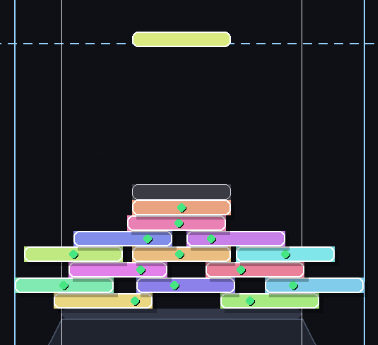
It is Christmas time: books appear in cheerful piles as gifts, and in some households the morning after brings not only a “hangover” but also an ambitious attempt to stack them and exploit “overhang” beyond the edge of a table. How far can a stack of identical “books” (idealized as rigid, frictionless blocks) extend beyond the edge of a table without toppling? We also provide a small Python game in which you can test your book-stacking skills: it implements the mechanics described here as interactive code and is linked from the essay [4].
1. The setup (what “x” means)
We model each book as a rigid block of length 


A block 
![{B_i=[x_i,\ x_i+1]}](https://s0.wp.com/latex.php?latex=%7BB_i%3D%5Bx_i%2C%5C+x_i%2B1%5D%7D&bg=ffffff&fg=000&s=0&c=20201002)


Endpoint reduction (key simplification).
If a block is supported on an overlap interval ![{[L,R]}](https://s0.wp.com/latex.php?latex=%7B%5BL%2CR%5D%7D&bg=ffffff&fg=000&s=0&c=20201002)


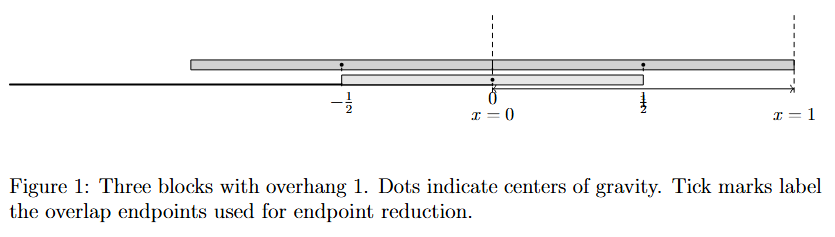
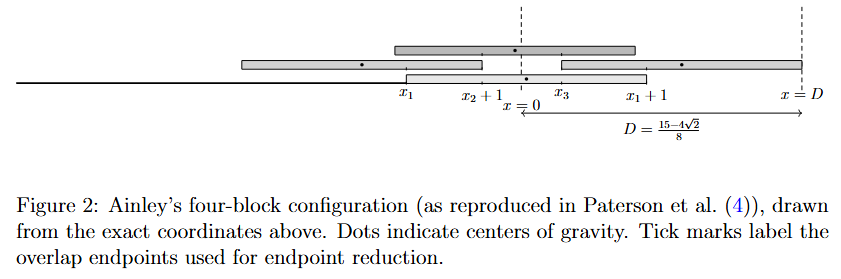
This is why the figures mark endpoints: those are the only places we need to “push up” in the model (Figure 1 and Figure 2).
2. Warm-up: three books, overhang 1
A small configuration (Figure 1) is
![{\displaystyle B_1=[-\tfrac12,\ \tfrac12],\qquad B_2=[-1,\ 0],\qquad B_3=[0,\ 1]. }](https://s0.wp.com/latex.php?latex=%7B%5Cdisplaystyle+B_1%3D%5B-%5Ctfrac12%2C%5C+%5Ctfrac12%5D%2C%5Cqquad+B_2%3D%5B-1%2C%5C+0%5D%2C%5Cqquad+B_3%3D%5B0%2C%5C+1%5D.+%7D&bg=ffffff&fg=000&s=0&c=20201002)
The rightmost edge is 


3. Ainley’s four-book configuration
A classical four-book arrangement due to Ainley [1], reproduced in Paterson et al. [2], achieves the overhang


With table edge at
![{\displaystyle \begin{aligned} B_1&=[x_1,\ x_1+1], & x_1&=-\frac{1+2\sqrt{2}}{8},\\[2mm] B_2&=[x_2,\ x_2+1], & x_2&=-\frac{51}{56}-\frac{5\sqrt{2}}{28},\\[2mm] B_3&=[x_3,\ x_3+1], & x_3&=\frac{7}{8}-\frac{\sqrt{2}}{2},\\[2mm] B_4&=[x_4,\ x_4+1], & x_4&=-\frac{103}{56}+\frac{13\sqrt{2}}{14}. \end{aligned} }](https://s0.wp.com/latex.php?latex=%7B%5Cdisplaystyle+%5Cbegin%7Baligned%7D+B_1%26%3D%5Bx_1%2C%5C+x_1%2B1%5D%2C+%26+x_1%26%3D-%5Cfrac%7B1%2B2%5Csqrt%7B2%7D%7D%7B8%7D%2C%5C%5C%5B2mm%5D+B_2%26%3D%5Bx_2%2C%5C+x_2%2B1%5D%2C+%26+x_2%26%3D-%5Cfrac%7B51%7D%7B56%7D-%5Cfrac%7B5%5Csqrt%7B2%7D%7D%7B28%7D%2C%5C%5C%5B2mm%5D+B_3%26%3D%5Bx_3%2C%5C+x_3%2B1%5D%2C+%26+x_3%26%3D%5Cfrac%7B7%7D%7B8%7D-%5Cfrac%7B%5Csqrt%7B2%7D%7D%7B2%7D%2C%5C%5C%5B2mm%5D+B_4%26%3D%5Bx_4%2C%5C+x_4%2B1%5D%2C+%26+x_4%26%3D-%5Cfrac%7B103%7D%7B56%7D%2B%5Cfrac%7B13%5Csqrt%7B2%7D%7D%7B14%7D.+%5Cend%7Baligned%7D+%7D&bg=ffffff&fg=000&s=0&c=20201002)
The overhang is the right edge of 

4. The force-tree idea (magnitudes) and the endpoint geometry (positions)
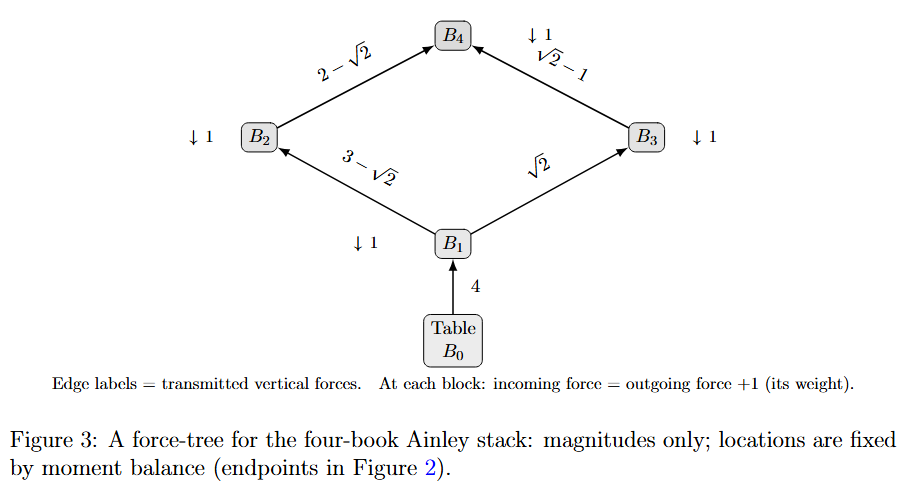
Paterson et al. [2] popularize a bookkeeping device: a tree of vertical force magnitudes.
Each book receives upward support from below, “spends”
The tree gives only how much force is transmitted. To prevent tipping, we also need where forces act. Moment balance fixes these positions, and endpoint reduction lets us assume they occur at overlap endpoints—exactly the ticks shown in Figure 2.
5. Detailed vertical force balance for all four books (Ainley stack)
The force tree can make it look as if “all forces point upward.” In fact, each book experiences both upward and downward vertical force vectors.
In static equilibrium, each book 


Top book 

- Upward vertical force vector at
:
.
- Upward vertical force vector at
:
.
- Downward weight force vector at
:
.
Force equilibrium: 
Middle-left book 
- Upward vertical force vector at
:
.
- Downward weight force vector at
:
.
- Downward vertical reaction force vector from
.
Force equilibrium: 
Middle-right book
- Upward vertical force vector at
:
.
- Downward weight force vector at
:
.
- Downward vertical reaction force vector from
.
Force equilibrium: 
Bottom book
- Upward vertical force vector at
(table on
- Downward weight force vector at
:
.
- Downward vertical reaction force vector from
.
- Downward vertical reaction force vector from
.
Force equilibrium: 

6. Force equilibrium vs. moment equilibrium (outer middle block in the Ainley stack)
Force equilibrium 


Consider the outer middle-right book 


Equivalently,

This says that the combined downward load on
7. How the geometry determines the forces (and the moments)
In this vertical-force model, the geometry does not determine the force magnitudes by itself.
What geometry determines is where forces are allowed to act: a book can only be supported where it overlaps what is below.
The actual magnitudes then follow from two equilibrium laws on each book:
force equilibrium 
Step 1: geometry gives allowable support points (endpoints).
If an upper book overlaps a lower book on an interval 

Step 2: force + moment equilibrium on one book (lever rule).
Suppose a book has a combined downward load of total magnitude 


Solving yields the endpoint forces

So force equilibrium fixes the sum 
Step 3: how to compute
If downward forces 


In particular, the book’s own weight contributes 
How this plays out in Ainley’s stack (one concrete check on
On the outer middle-right book 


Geometry says ![{[L,R]=[x_3,\ x_1+1]}](https://s0.wp.com/latex.php?latex=%7B%5BL%2CR%5D%3D%5Bx_3%2C%5C+x_1%2B1%5D%7D&bg=ffffff&fg=000&s=0&c=20201002)


8. Balance versus stability (a small reality check)
The configurations above are balanced: they satisfy equilibrium with nonnegative vertical reactions. Some are critical in the sense that forces concentrate at endpoints. A physical stack may need a tiny perturbation or a touch of friction to be robustly stable; this distinction is discussed in [2].
9. Try it yourself (interactive code)
A companion Pygame implementation [4] lets you experiment with the same mechanics. It works in pixel coordinates, but the mapping is conceptually simple: one book length in the paper corresponds to one book width in pixels. The game computes a resultant load position and routes it to bracketing overlap endpoints (an “endpoint-tree” implementation of the same model).
Appendix for nonlinear optimization readers
The full PDF version of this note contains an additional section that formulates Ainley’s four-block arrangement as a small nonlinear programming model (with endpoint-force variables) and checks KKT conditions for the classical Ainley solution. Readers familiar with nonlinear optimization may prefer that presentation; see the PDF linked in the references.
References
- S. Ainley, “Finely balanced,” Mathematical Gazette, 63 (1979), 272.
- M. Paterson, Y. Peres, M. Thorup, P. Winkler, and U. Zwick, “Maximum overhang,” American Mathematical Monthly, 116 (2009), 763–787.
- M. Paterson and U. Zwick, “Overhang,” American Mathematical Monthly, 116 (2009), 19–44.
- M. T.M. Emmerich, BookStacker (interactive Pygame trinket), https://trinket.io/pygame/f617e94d9da2 (accessed 2025-12-29).
- Wikipedia, “Block-stacking problem,” https://en.wikipedia.org/wiki/Block-stacking_problem (accessed 2025-12-29).
- Full PDF version of this essay (with the NLP/KKT appendix), Maximum Overhang Report (accessed 2025-12-29).
 Michael Emmerich