Michael Emmerich – 29 June 2025

1. Introduction
Positive integers and their fundamental building blocks, the prime numbers, exhibit a rich combinatorial structure. This essay is part of a series that aims to derive some of the intriguing properties of integers using only elementary mathematical tools, thereby making them accessible to a broader audience. We do this by adopting the prime-vector representation (Emmerich, 2025), in which rational numbers can be placed naturally on a grid whose axes correspond to prime bases and their exponents. In this picture, number theory becomes a combinatorial game of rearranging positions on the grid and counting possibilities.
In this essay, we revisit the fundamental notions four: coprimality, divisibility, and the arithmetic functions that measure them, in particular the Euler totient function, through the lens of representation of the prime vector (Emmerich, 2025). By recasting every positive rational as a vector of prime exponents, arithmetic collapses to ordinary integer addition and subtraction of coordinates. Within this coordinate system
- coprimality and the totient function emerge as simple sign-pattern conditions on pairs of prime vectors;
- divisibility properties translate to component-wise ordering of vectors; and
- the divisor-counting function
becomes a lattice-point enumeration problem.
Special attention is given to Euler’s totient function, which has a nice interpretation in a group-partition scheme, which we will also employ to reprove Gauss’s sum of totients lemma. This lemma provides one interesting bridge between additive and multiplicative structures in positive integers.
2. Prime-Vectors
Let us briefly review the basics of the prime vector representation, as introduced in (Emmerich, 2025). Prime vectors are in several aspects a convenient representation of positive rational numbers. Prime vectors make it possible to handle rational numbers in their reduced form, using only integers in their representation, and to combine integers, as well as positive integers, multi-dimensionally by means of integer vector addition and subtraction. Let 


and is represented by its prime vector

with only finitely many non-zero entries. In this representation, multiplication and division of rational numbers can be reduced to integer addition and subtraction.
Lemma 1 (Component-wise operations) For all positive rationals
where the addition/subtraction is component-wise.

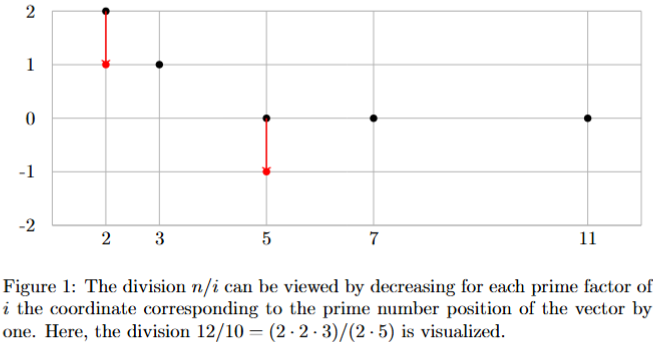
The beauty of this reformulation of integer division and multiplication is that these operations can now be naturally performed as simple geometric shifting operations on a grid with the coordinate axis being the prime bases and their exponents. See Figure 1 for an example.
Another notable advantage of the prime vector representation is that it encapsulates rational numbers in their simplified or reduced form, where the numerator is denoted by the positive component, and the divisor is denoted by the negative component (Emmerich, 2025). For example, the prime vector 

Observe the analogy with logarithmic rules; however, in this framework, all computations are purely integer-based, avoiding the use of transcendental numbers altogether.
3. Divisibility
It is well known that all divisors of a positive integer can be constructed by combinations of its prime factors. Then it is easy to verify the following theorems that relate prime vectors to divisors.
Lemma 2 Letand
denote two positive integers with
then
, iff
, i.e. the difference of the prime vectors has only non-negative components.
and we can now find the set of all divisors.
Lemma 3 The set of all positive integer divisors of the positive integeris provided by
and we can count the number of divisors by product:
.
Example: Let us find the divisors of 


4. Co-primality
Co-primality can be regarded as the conceptual antithesis to divisibility. In this context, the focus is on identifying integers whose sets of prime factors exhibit no commonality.
Lemma 4 (Coprimality criterion) Letand
be the prime vectors of two positive integers. They are co-prime if and only if their positive coordinates do not overlap, that is:
Example. Let
and
. Then:
and their positive coordinates are in disjoint positions. Hence,
and
are co-prime.
In contrast, let
, so
. Then
and
both have positive entries in the same indices, so
are not co-prime.


Corollary 5 (Sign pattern of the difference) For coprime integer vectors,
is exactly positive at the coordinates where
is positive and negative exactly where
is positive.
Equivalently,


Remark 1 Observe that the positive part of a prime vectorwhich we denote with
can be interpreted as the prime vector of the numerator, while the analogously defined negative part of a prime vector
serves as the prime vector of the divisor in the simplified fraction
. Take, for example, the vector
, which corresponds to the fraction
.
Example. Using the co-prime 


5. Euler’s totient function
Euler’s totient function 
Definition 6 (Euler’s totient) For a positive integerwith
being the largest common divisor.

The arithmetic function 
Lemma 7 Letbe the prime factorization of a positive integer
. Then:

Proof: The totient function 
Let us first compute the formula for the totient of a prime power:

We are counting the number of integers 


as claimed. 
6. Euler’s Totient Function from a Prime-Vector Perspective
We now characterize Euler’s totient function in terms of prime vectors. Fix a positive integer 


Then 

i.e., the positive part of the vector difference recovers the original vector 
Corollary 8 (Totient count via prime vectors) Let

Example: For 


This structure reveals a natural path to Gauss’s classical identity:
Theorem 9 (Gauss’ sum of totients identity) For every positive integer,

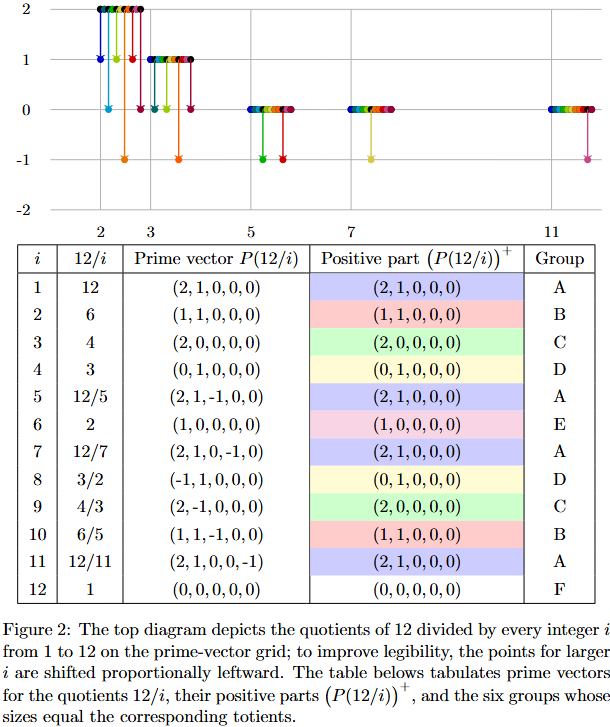
Before stating a proof of this theorem, which was first proved by Gauss (Gauss, 1801) let us look at an example.
Example: Let us looking at the sum of totient rule for the example 


Group A  |  , indices , indices  ( ( ) ) |
Group B  |  , indices , indices  ( ( ) ) |
Group C  |  , indices , indices  ( ( ) ) |
Group D  |  , indices , indices  ( ( ) ) |
Group E  |  , indices , indices  ( ( ) ) |
Group F  |  , index ( , index ( ) ) |
Adding the group sizes 
Let us now proof Gauss’s sum of totient identity by making some use of prime vector notation. Let 


Note that the unique prime vector representation of the reduced-form rationals ensures that all rows are distinct (see (Emmerich,2025)), so we get exactly
Group the rows by their fourth entry, the positive part 

of the index set 
Each block 


Lemma 10 shows that the size of a group 

Lemma 10 (Lemma on Group Sizes) For a blockchoose any index
and set
Then

Proof: Firstly, let us explain why a group 


The first step is to divide 


Let us now argue why no additional elements to the ones discussed above can join the group 
Firstly, consider 


Secondly, consider the other case, that is, 


The sum of totient lemma follows from the auxiliary lemma and the fact that the group sizes sum up to 
The foregoing argument closely mirrors the classical proof that counts reduced fractions. However, expressed in prime-vector language, every rational automatically appears in lowest terms because each exponent is split into its positive and negative parts. This coordinate-wise view might make the divisibility reasoning more transparent.
7. Conclusion
Expressing numbers in prime-vector form makes questions of divisibility and related prime-number properties surprisingly transparent. In this framework we were able to give elementary derivations for criteria of coprimality, the divisor function
So far, however, prime-vector notation has not produced decisively simpler proofs of the deeper results about
Computer science reminds us that choosing the right data structure can turn an opaque problem into an elegant algorithm. By analogy, refining number representations that are tailored to arithmetic structure may yet unlock new methods for studying the positive integers. Pursuing such representations — and the combinatorial reasoning they invite — therefore appears to be a promising direction for further research.
References
Emmerich, M. T. M. (2025, January 12). On prime vectors and unique factorization of rationals. Mathematical Playground. http://www.emmerix.net
L. Euler, Theorematum quorundam ad numeros primos spectantium demonstratio (A proof of certain theorems regarding prime numbers), Commentarii Academiae Scientiarum Petropolitanae 8 (1741), 141–146. Eneström index E54. Latin original and an English translation by D. Zhao available at the Euler Archive.
L. Euler, Theoremata arithmetica nova methodo demonstrata (Demonstration of a new method in the theory of arithmetic), Novi Commentarii Academiae Scientiarum Petropolitanae 8 (1763), 74–104. Eneström index E271. Facsimile at the Euler Archive.
L. Euler, Speculationes circa quasdam insignes proprietates numerorum (Speculations about certain outstanding properties of numbers), Acta Academiae Scientarum Imperialis Petropolitinae 4 (1784), 18–30. Eneström index E564. Latin original and an English translation by J. Bell available at the Euler Archive.
C. F. Gauss, Disquisitiones Arithmeticae. Leipzig: Gerhard Fleischer, 1801. (English translation by A. A. Clarke, Yale University Press, 1965.)
E.R. Tou, “Math Origins: The Totient Function,” Convergence (MAA), September 2017. DOI:\,10.4169/convergence20170923.
R. Wilson, Number Theory: A Very Short Introduction, Oxford University Press, 2020.
 Michael Emmerich