A New Phase Transition for Energy-Minimal Point Distributions on the Interval
Date: 2026-03-28
Author: Michael T. M. Emmerich
There are at least two very natural ways to spread 
![[0,1]](https://s0.wp.com/latex.php?latex=%5B0%2C1%5D+&bg=ffffff&fg=000000&s=0&c=20201002)
If one maximizes the sum of pairwise distances, then the answer is extreme clustering: the best strategy is to place roughly half the points at 

If instead one maximizes the minimum distance between points, then the answer is the opposite extreme: uniform spacing. In that case the points should be spread evenly across the interval.
A closely related singular model is given by the Riesz family, where one minimizes the sum of reciprocal distances raised to a power:

Here short distances are punished very strongly, and as 

So one extreme favors clustering, while the singular Riesz extreme favors evenly spaced points. This raises a natural playground question: is there a smooth family of declining kernels that interpolates between these two tendencies, but is less singular than Riesz
That was my motivation for looking at the bounded family

and the associated energy

Because 

That sounds innocent. But the answer depends dramatically on the exponent 
The
A helpful way to think about the problem is this: among all 
This makes the problem subtly global. Moving one point can improve some distances and worsen others. A point in the interior interacts with points on both sides. A point at an endpoint can be very far from points near the opposite endpoint, but may also encourage collisions nearby. So the real question is not simply “spread the points out evenly,” but rather:
- when is it worth keeping all
- when do collisions become beneficial,
- and how many points should pile up at the endpoints?
That is the
Why the exponent matters
The local shape near zero is controlled by

So 


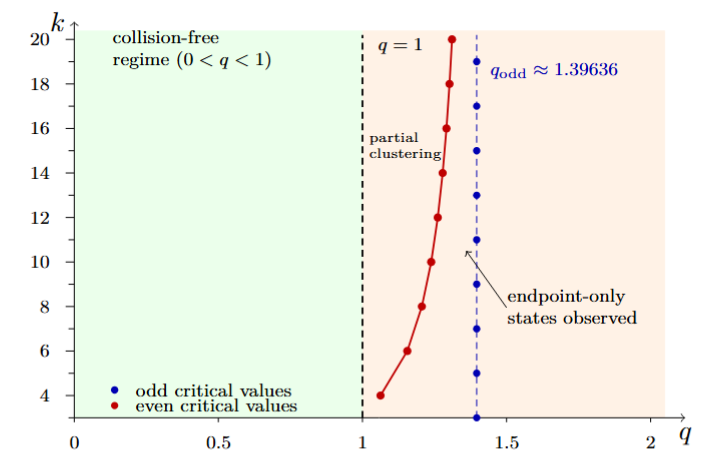
The $(q,k)$ phase diagram in a nutshell
- For
- At
- For
beyond which interior points disappear completely.
- For odd
- For even
The easy intuition for
Here the kernel has a cusp at the origin. If two points collide, opening that zero gap by a tiny amount 


The threshold
At

where 
The surprising answer just above
The genuinely surprising part comes just above the threshold. One might guess that for every
There is a whole intermediate window with 
In that range, collisions may occur, but the optimal
So the answer for slightly super-threshold
- collisions are no longer forbidden,
- but full endpoint collapse is still not yet optimal,
- and only beyond a second transition at
do all interior points disappear.
That two-stage story is what makes the phase diagram interesting, and it is exactly this transition structure that seems to be new here.
Odd
For odd 

and the endpoint-only split

These two branches cross at the exact value
![\displaystyle q_{2m+1}=\frac{\log\!\Bigl(1/\bigl[-\log((1+e^{-1})/2)\bigr]\Bigr)}{\log 2}\approx 1.396363475.](https://s0.wp.com/latex.php?latex=%5Cdisplaystyle+q_%7B2m%2B1%7D%3D%5Cfrac%7B%5Clog%5C%21%5CBigl%281%2F%5Cbigl%5B-%5Clog%28%281%2Be%5E%7B-1%7D%29%2F2%29%5Cbigr%5D%5CBigr%29%7D%7B%5Clog+2%7D%5Capprox+1.396363475.+&bg=ffffff&fg=000000&s=0&c=20201002)
This is striking: the critical value does not depend on 
Even
For even 


These values climb steadily upward and stay below the odd universal value in the tested range.
How to read the whole picture
The emerging $(q,k)$-diagram therefore has three visible zones:
- Collision-free zone:
- Partially clustered zone: first at
- Endpoint-only zone: for
, where the tested minimizers live entirely on
.
So the “surprising answer” is that the threshold
The opposite extreme:

At the other end of the diagram, the minimizing configurations do not converge to equally spaced points. Instead, the first-order asymptotics select the classical Fekete configuration on

So even the small-
Detailed report
For the full technical write-up with proofs, formulas, tables, and diagrams, see the detailed report (PDF).
Why this is a nice playground problem
This is exactly the kind of mathematical toy model that rewards experimentation. The definition is short, the interval is one-dimensional, and yet the optimal configurations show symmetry, clustering, parity effects, exact formulas, and a nontrivial phase diagram. It is a small problem with unexpectedly expressive behavior.
Open questions
- Is the odd critical value
the true global transition for every odd
- Do the even critical exponents keep increasing with
- Can one describe the full large-
References and background
- S. V. Borodachov, D. P. Hardin, and E. B. Saff, Discrete Energy on Rectifiable Sets, Springer Monographs in Mathematics, 2019.
- D. P. Hardin and E. B. Saff, Discretizing manifolds via minimum energy points, Notices Amer. Math. Soc. 51 (2004), 1186-1194.
- D. P. Hardin and E. B. Saff, Minimal Riesz energy point configurations for rectifiable
-dimensional manifolds, Adv. Math. 193 (2005), 174-204.
- F. Pausinger, Greedy energy minimization can count in binary: point charges and the van der Corput sequence, Ann. Mat. Pura Appl. 200 (2021), 165-186.
- S. Steinerberger, Exponential sums and Riesz energies, J. Number Theory 182 (2018), 37-56.
Read my paper with detailed derivations and closed form expressions:
Emmerich, M. T. M. (2026, March 28). Phase transitions for the one-dimensional kernel family e^(-|x-y|^q): Critical exponents, collisions, and endpoint clustering on the unit interval [PDF, CC BY 4.0]. Mathematical Playground Blog.
Link to PDF Document
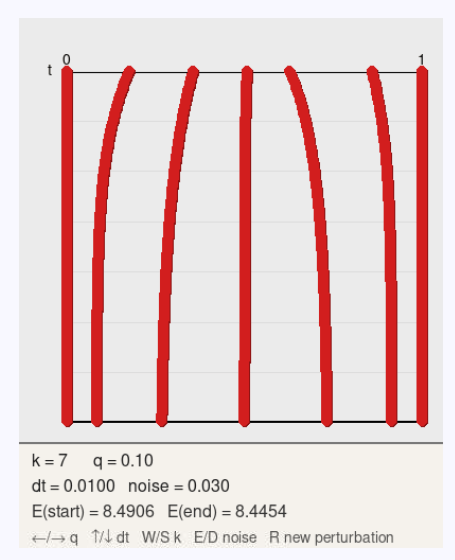
Try my online python app to experiment with different q and k settings and see how a gradient flow optimizer finds the optimal energy minimal configuration starting from a near uniform distribution. https://trinket.io/library/trinkets/a02e463476c5
 Michael Emmerich