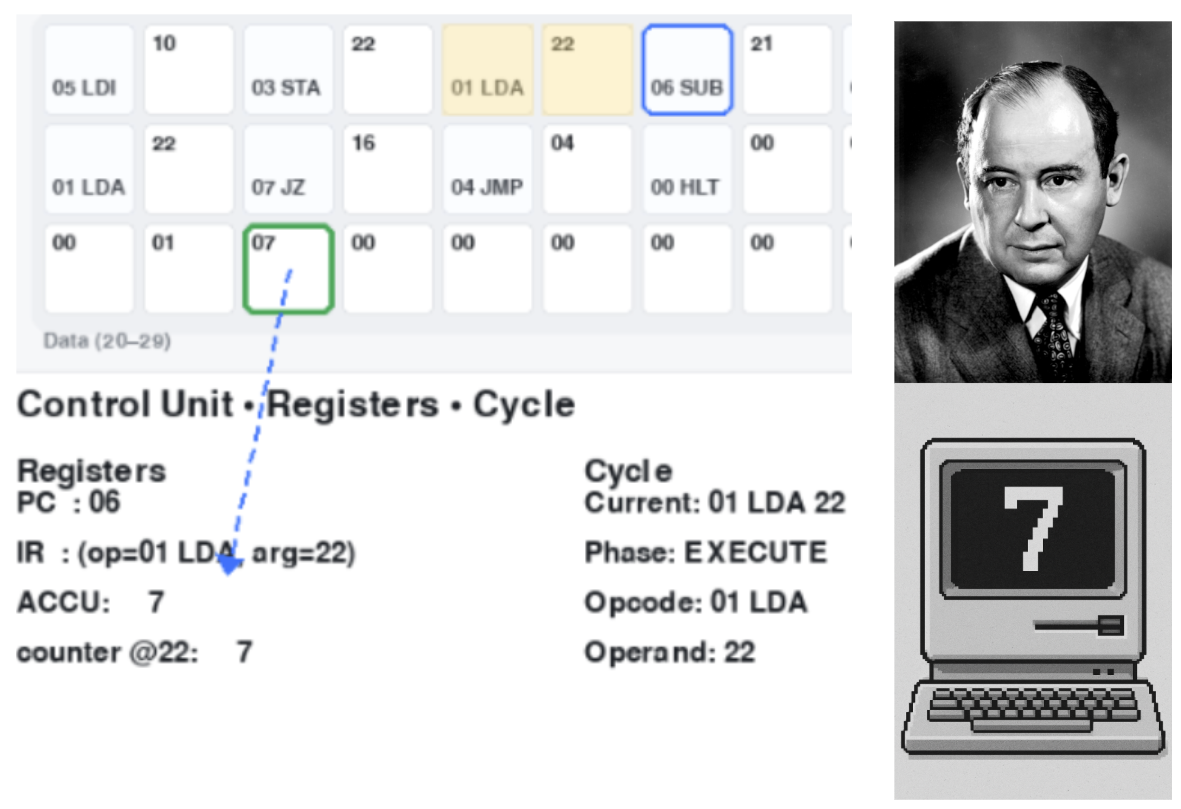
This interactive mini-simulation shows a stored-program computer in the classic von Neumann style executing a tiny machine-code program that counts down from 10 to 0. You can watch the registers and memory interact during the fetch–decode–execute cycle. It’s a compact demonstration of the model that underlies almost all modern computing—right up to the CPUs and GPUs that run today’s AI systems.
How to use it
- Space — pause / resume
- → — single-step one micro-operation
- R — reset the program
Registers and Abbreviations
A few key registers are displayed in the panel:
- PC (Program Counter): holds the address of the next instruction to fetch.
- IR (Instruction Register): stores the current instruction (opcode and operand).
- ACC (Accumulator): the main working register for arithmetic and logic.
The program also uses a counter stored in memory cell [22], which is decremented each loop.
Instruction Set (Opcodes and Mnemonics)
Each instruction consists of an opcode (a number) and an operand (a memory address or value). The simulation uses a very small instruction set:
| Opcode | Mnemonic | Meaning |
|---|---|---|
| 0 | HLT | Halt execution |
| 1 | LDA a | Load ACC from memory address a |
| 2 | ADD a | Add mem[a] to ACC |
| 3 | STA a | Store ACC into memory address a |
| 4 | JMP a | Jump to address a unconditionally |
| 5 | LDI v | Load immediate value v into ACC |
| 6 | SUB a | Subtract mem[a] from ACC |
| 7 | JZ a | If ACC = 0, jump to address a |
The Countdown Program
The code below shows how the countdown is achieved. It starts by loading the number 10, storing it in [22],
then repeatedly subtracting 1 (from [21]) until the counter reaches 0.
00: LDI 10      ; ACC ← 10
02: STA 22      ; counter ← 10
04: LDA 22      ; ACC ← counter
06: SUB 21      ; ACC ← ACC - 1
08: STA 22      ; counter ← ACC
10: LDA 22      ; ACC ← counter
12: JZ  16      ; if ACC == 0, jump to HALT
14: JMP 04      ; loop back to subtract again
16: HLT 00      ; stop
An interesting question for reviewing your understanding would be how to change this program to one that counts from 1 to 10.
Why this matters (and how it links to AI)
This simple loop is representative of how real processors run every program: a stream of numeric opcodes acting on data in memory. Modern AI workloads (from Python frameworks to CUDA kernels) are ultimately translated into such instruction streams for CPUs/GPUs that still follow the same stored-program principle—albeit with many layers of caching, pipelining, and parallelism.
Historical context
The stored-program concept was articulated in John von Neumann’s 1945 First Draft of a Report on the Electronic Discrete Variable Automatic Computer (EDVAC), which described a machine with a memory holding both code and data, a central arithmetic unit, and a control unit.¹ The idea rapidly influenced post-war computer design and is often summarized as the von Neumann architecture.² The first electronic stored-program to run successfully executed on the Manchester “Baby” on 21 June 1948, demonstrating the approach in practice.³
- John von Neumann, First Draft of a Report on the EDVAC (1945). See e.g. MIT/STS scan: PDF.
- Overview of the stored-program concept: Encyclopædia Britannica.
- Manchester Baby (Small-Scale Experimental Machine) — first stored-program run, 21 June 1948: University of Manchester.
 Michael Emmerich