Michael Emmerich, August 20th 2025
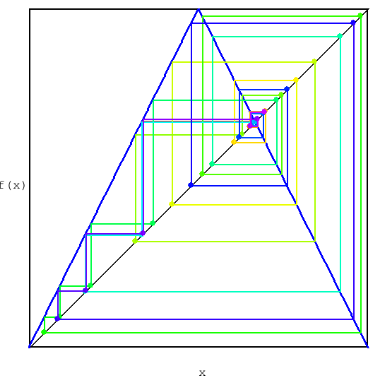
Chaotic time series can emerge from very simple deterministic rules. The tent map is a classical example. It shows how fixed points can be unstable, how orbits diverge, and how randomness-like behavior arises from a piecewise linear rule.
The Tent Map
The tent map is defined on the interval ![{[0,1]}](https://s0.wp.com/latex.php?latex=%7B%5B0%2C1%5D%7D&bg=ffffff&fg=000000&s=0&c=20201002)

with parameter 

The reader is encouraged to examine Figure 1, which provides a visualization of the cobweb plot together with the corresponding time series. Standard references on cobweb diagrams and the theory of interval maps have been included at the end of this essay. For those interested in a deeper exploration, we invite the reader to experiment with the interactive Python source code provided in the appendix.
Fixed Points and Instability
A fixed point 


If 

Cobweb Visualization
A cobweb diagram shows iterations graphically. Starting from some 


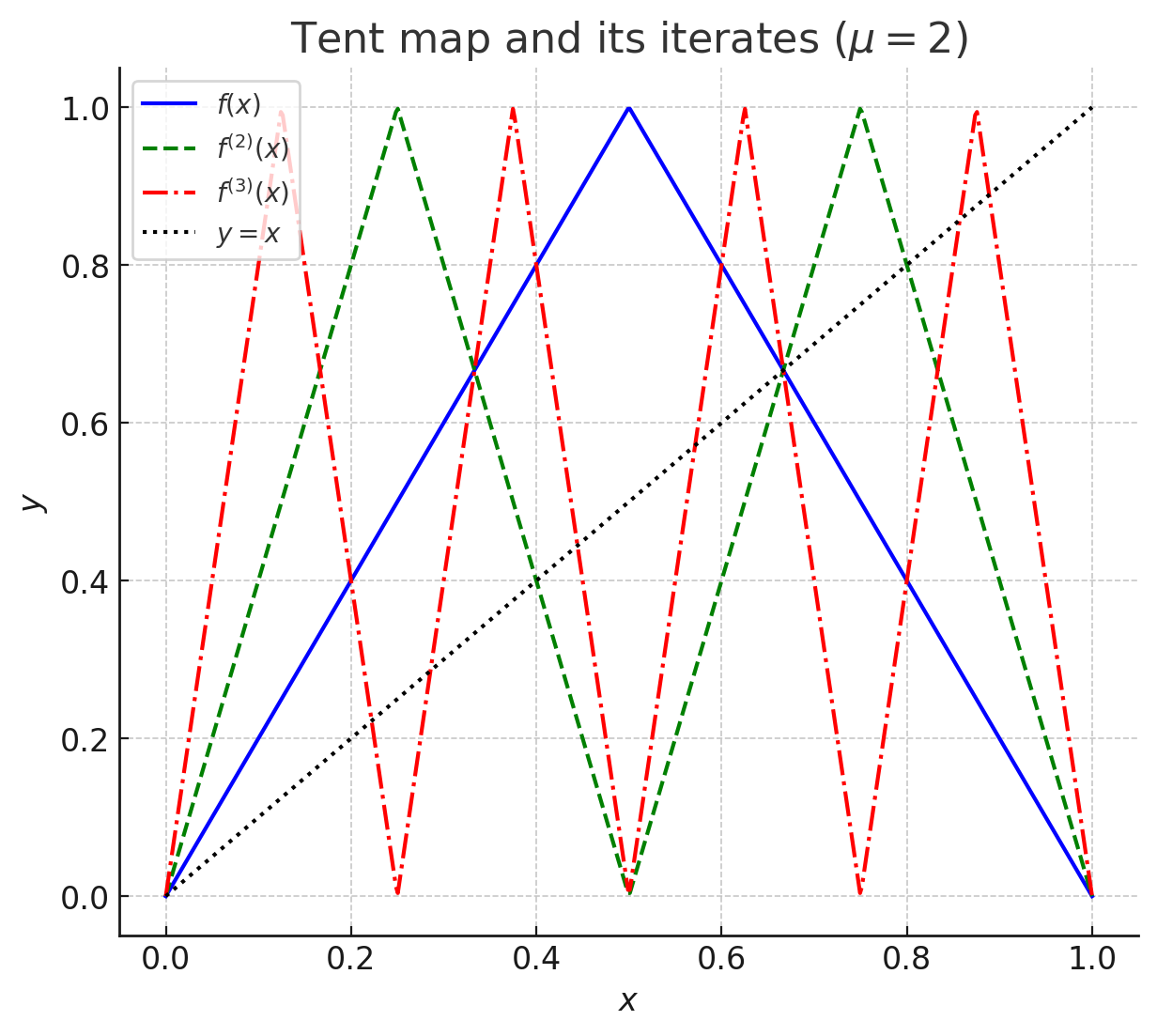
Periodic Points and Higher Iterates
An orbit of period 


Invariant Density and Lyapunov Exponent
Iterating the tent map produces a long-term distribution called the invariant density. For

This means the orbit spends equal amounts of time in each part of the interval. The Lyapunov exponent measures how fast nearby orbits diverge. For 
The Binary Shift Map Connection
The tent map with
![\displaystyle S(x)=2x \pmod{1}, \quad x \in [0,1].](https://s0.wp.com/latex.php?latex=%5Cdisplaystyle+S%28x%29%3D2x+%5Cpmod%7B1%7D%2C+%5Cquad+x+%5Cin+%5B0%2C1%5D.&bg=ffffff&fg=000000&s=0&c=20201002)
If 


Each iteration discards the first digit. This shows that the tent map and the binary shift share the same chaotic structure. Iterating them resembles tossing a fair coin.
For rational numbers 


Another way to describe periodicity is that points of exact period 

These correspond to primitive binary blocks of length
Chaos and Number Theory
The connection between the tent map and the binary shift hints at deeper parallels with number theory. The tent map has a dynamical zeta function encoding periodic orbits, while number theory studies the Riemann zeta function, which encodes the primes. In both cases, apparent randomness emerges from deterministic rules. Chaos in dynamics and irregularity in primes may thus be seen as two sides of pseudorandomness. We would like to futher explore this connection and provide more details on the binary shift map in a future blog post.
Conclusion
The tent map, though defined by a simple formula, displays chaos: repelling fixed points, exponential divergence, dense periodic orbits, and uniform distribution. Its link with the binary shift map shows how deterministic systems can mimic random behavior, much like the distribution of prime numbers.
- P. Collet and J.-P. Eckmann. Iterated Maps on the Interval as Dynamical Systems. Birkhäuser, Boston, 1980.
- R. L. Devaney. An Introduction to Chaotic Dynamical Systems. 2nd edition, Addison-Wesley, Redwood City, CA, 1989.
Figure 1:
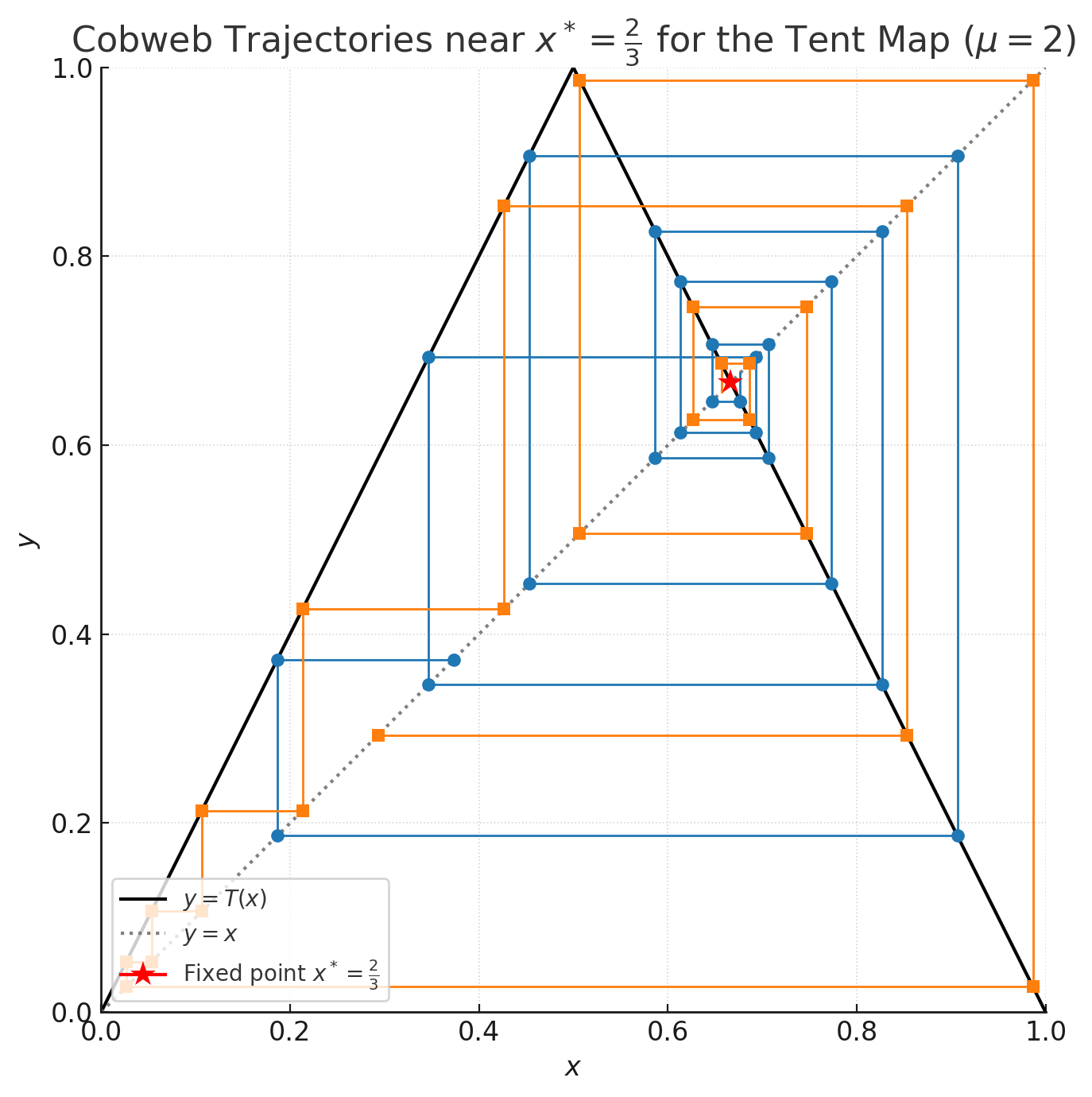
Figure 2:
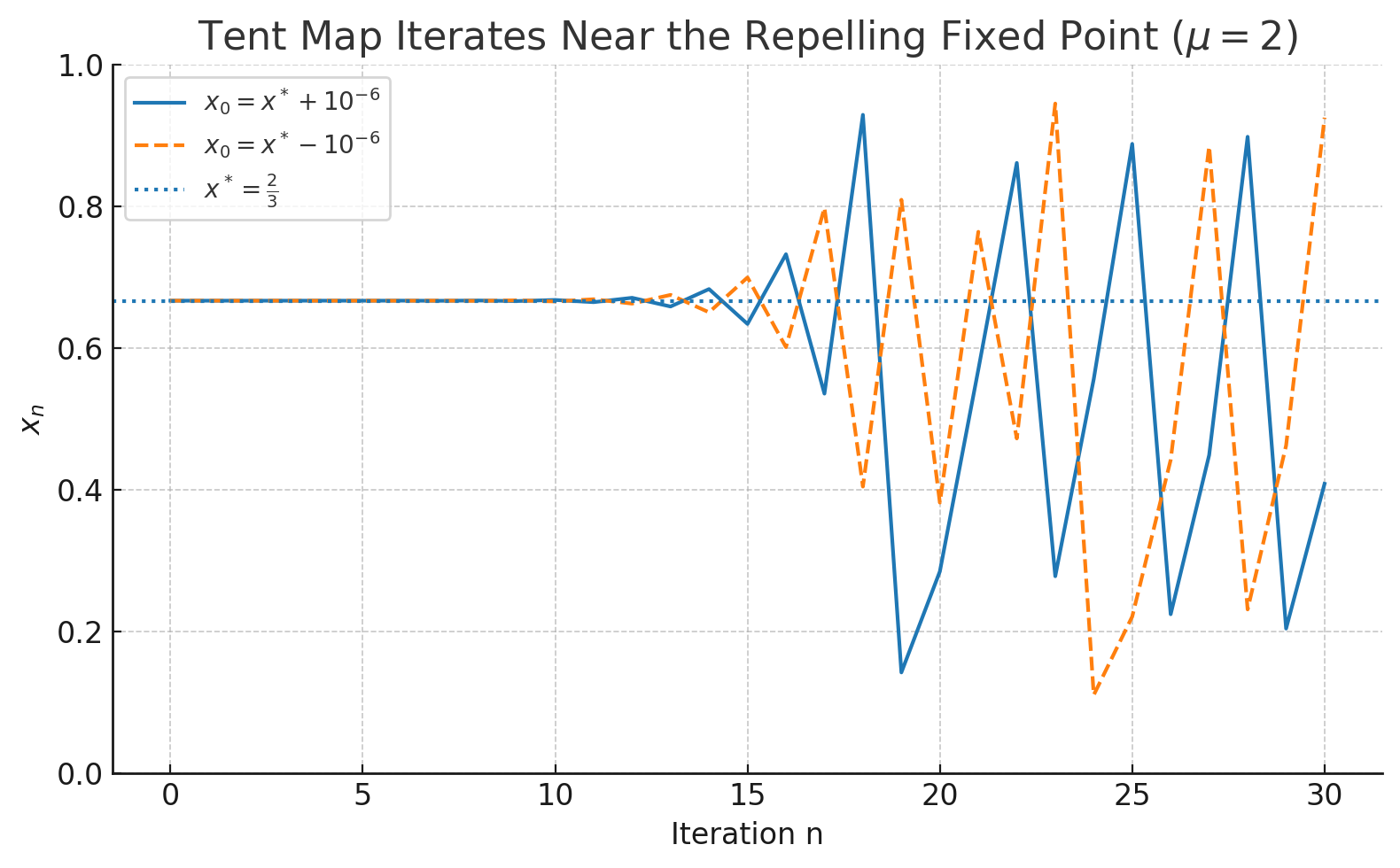
Figure 3
Interactive Python Source code on Trinket.io:
https://trinket.io/library/trinkets/077d82abad0b
 Michael Emmerich