
Essay by Michael Emmerich, October 11th, 2024
Imagine a peaceful autumn day where leaves gently fall, covering a patch of land. The land can be represented as a grid or matrix with 
Link to Maple Leaves Interactive Source Code Demo (trinket.io)
This situation mirrors a common computational problem where we start with a bit string of length
The process of covering all
Lemma 1Let
where
is the
For large
where
is the Euler-Mascheroni constant. (This constant is an interesting object of study in its own sake and there are open mathematical questions related to it, e.g., whether or not it is a rational number.) Therefore, the expected number of steps to cover all spots is approximately:
Thus, for large
, with a small additive constant due to
.


Proof: We consider the number of steps required to flip all 


In general, after 


Thus, the total expected number of steps to flip all

where 
Expected Number of Uncovered Spots Over Time
At step 
![\displaystyle E[\text{uncovered spots at step } t] = n \times \left( 1 - \frac{1}{n} \right)^t](https://s0.wp.com/latex.php?latex=%5Cdisplaystyle++E%5B%5Ctext%7Buncovered+spots+at+step+%7D+t%5D+%3D+n+%5Ctimes+%5Cleft%28+1+-+%5Cfrac%7B1%7D%7Bn%7D+%5Cright%29%5Et+&bg=ffffff&fg=000000&s=0&c=20201002)
This formula describes an exponential decay, where the number of uncovered spots decreases over time as leaves continue to fall.
Visualization
The following plot illustrates the dynamics of this process, showing how the number of uncovered spots decreases as leaves continue to fall.
As seen, the number of uncovered spots decreases rapidly at first but slows down as fewer uncovered spots remain. This is typical behavior predicted by the coupon collector’s problem.
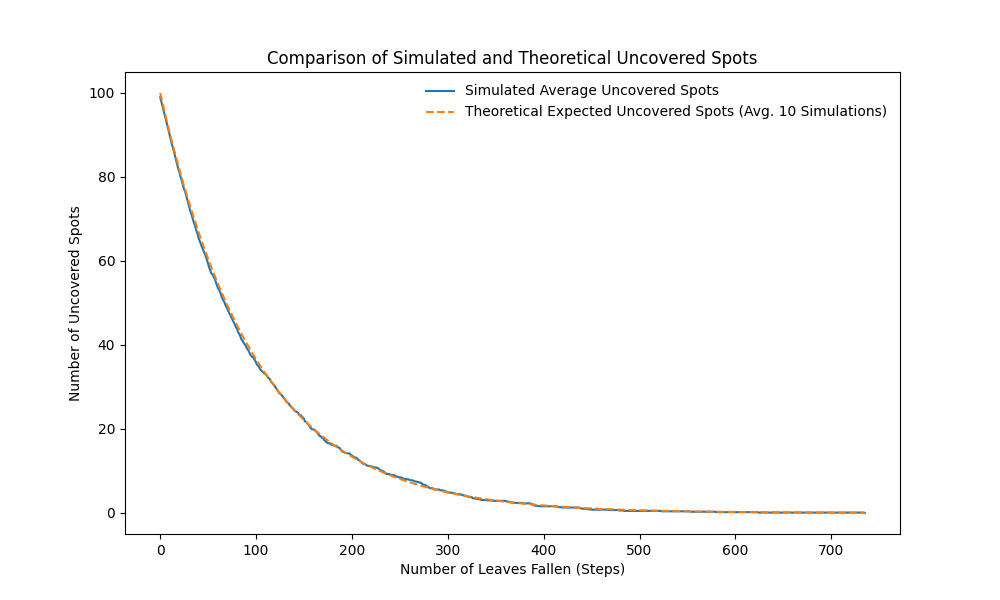
Figure 1Comparison of Simulated and Theoretical Expected Uncovered Spots. The solid line represents the simulated average number of uncovered spots over time, while the dashed line shows the theoretical expectation.
The Coupon Collector problem was made popular by William Feller (see references) under that name but has been studied earlier by mathematicians. It has many applications throughout mathematics of stochastic systems. Notably, it is even related to our perception of the flow of time, as we perceive time to proceed faster when similar events are repeating.
William Feller’s “An Introduction to Probability Theory and Its Applications” (first published in 1950)
Appendix (python code to produce the plot):
import numpy as np
import matplotlib.pyplot as plt
# Simulation parameters
n = 100  # Number of places (size of the patch of land)
trials = 10  # Number of simulations to average the results
# Function to simulate the process
def simulate_leaves_falling(n):
    uncovered_spots = n
    steps = 0
    uncovered_history = []
    covered = np.zeros(n)  # All spots are initially uncovered
    while uncovered_spots > 0:
        # Randomly pick a place and cover it
        place = np.random.randint(0, n)
        if covered[place] == 0:  # If the place is uncovered
            covered[place] = 1  # Cover it
            uncovered_spots -= 1
        uncovered_history.append(uncovered_spots)
        steps += 1

    return uncovered_history
# Average results over multiple trials
max_steps = 0
all_simulations = []
for _ in range(trials):
    result = simulate_leaves_falling(n)
    all_simulations.append(result)
    max_steps = max(max_steps, len(result))

# Align results by padding shorter simulations with the last value
for i in range(len(all_simulations)):
    all_simulations[i] = np.pad(
        all_simulations[i], (0, max_steps - len(all_simulations[i])),
        'edge'
    )
# Compute the average uncovered spots at each step
avg_uncovered = np.mean(all_simulations, axis=0)

# Formula for theoretical uncovered spots:
# E[uncovered spots at t] = n * (1 - 1/n)^t
theoretical_uncovered = [
    n * (1 - 1 / n) ** t for t in range(max_steps)
]
# Plot both the simulation results and the corrected theoretical curve
plt.figure(figsize=(10, 6))
plt.plot(
    avg_uncovered, label="Simulated Average Uncovered Spots"
)
plt.plot(
    theoretical_uncovered,
    label="Theoretical Expected Uncovered Spots (Avg. 10 Simulations)",
    linestyle='--'
)
plt.title(
    "Comparison of Simulated and Theoretical Uncovered Spots"
)
plt.xlabel("Number of Leaves Fallen (Steps)")
plt.ylabel("Number of Uncovered Spots")
plt.grid(False)
plt.legend(loc='upper right', frameon=False,)
# Save the plot as a PNG file
plt.savefig("C:\\Users\\emmer\\Downloads\\dynamic_plot_plus.png")
plt.show()
 Michael Emmerich
One response to “Of Autumn Leaves and Coupon Collectors”
[…] Nature doesn’t just have averages; it has extremes—the hottest day, the strongest wind, the largest daily rainfall, the highest flood. For extremes, a universal statistical law often appears: the Gumbel distribution. In this post, we meet it through a simple and realistic story about annual maximum rainfall, learn how a basic normalization makes its shape universal, and see how the constant (Euler–Mascheroni) sneaks in both here and in the coupon collector problem. […]