
On Periodic Patterns in the Prime Clockwork – September 15th, 2024, Michael Emmerich
I have two rotating gears, with 90 and 54 teeth. When do the starting points of these gears align?
When do the gears align again? The textbook answer is the least common multiple—though for two gears, their alignment is simply the product of their teeth, if and only if those gears are coprime. This mechanical precision can even define what it means to be prime. In this essay, we visit the clockwork of prime cycles, which generates integers and primes not by traditional means of divisibility or multiplication, but by following a method that generates the configurations of the cog wheels step-by-step, where each move generates a new configuration until all possible configurations were encountered and the wheels are aligned again.
This essay builds on the theories of the ‘prime clockwork’ and ‘prime vectors’ by focusing on recurring modulus combinations. It proves an upper bound for prime density and shows integer factorizations as zeros of a complex function, offering a visualization of the prime clockwork which we will present as interactive python code.
The prime clockwork (
Emmerich24b) is an automaton that generates integers one-by-one in their prime factorization. It uses the metaphor of an array of different clocks, each congruent with a prime number. As a whole, the prime clockwork generates the integers (total seconds that have passed) starting from one, step-by-step as prime vectors, that is, in their unique integer factorization. The prime clockwork uses only integer addition and comparisons, avoiding division and multiplication and each subsequent state of the clockwork depends solely on the preceding state.
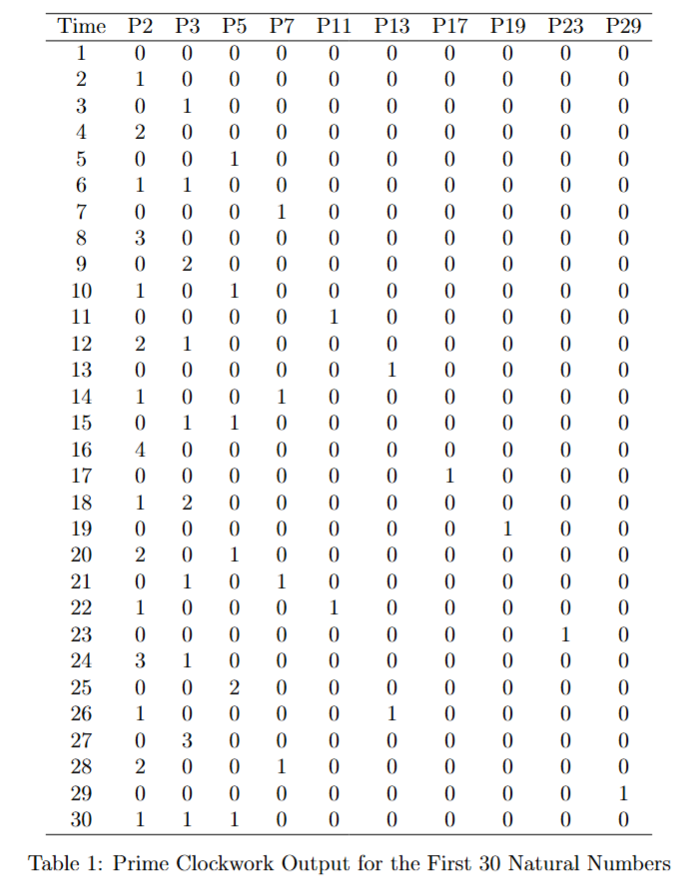
We can depict the output of the prime clockwork as a table (See Table 1), each row representing an integer, and each column associated with a prime 
In this essay will discuss the following topics:
- Subsets of Columns and Long Cycles: Fixing columns tied to prime moduli creates long cycles of repeated configurations over time.
- Cycle Length: The length of these cycles is exactly the product of the primes associated with the selected columns.
- Combination of modulus values (‘second counters’): Within each long cycle, the seconds counters
with
of the prime clocks go through all possible combinations.
- Visualization of Prime Clocks as Complex Functions: Representing the clockwork with time dependent exponential functions with complex exponents (that appear in the plot as concentric circles) represents the prime clockwork as points orbiting the origin at a radius that is proportional to the defining prime number of a clock; all points move with exactly the same speed. Each alignment of points with the positive real axis of a subset of prime clocks marks the end of a long periodic cycle, revealing prime factor of the integer that represents the given time.
The concept of prime vectors and prime clockwork offers a different perspective on integers and prime numbers. While the theoretical results might not all new in the well researched field of number theory, we hope that the new perspective can offer some new ideas. We are certainly inspired by number theory’s rich history but we develop lemmas from basic principles and prefer to build theories up from scratch using elementary methods, driven by curiosity. Please leave a comment to reference related work or identify errors.
1. Prime Vectors
Prime vectors, introduced for instance in
Emmerich 2024a represent 


2. Prime Clockwork
The prime clockwork was introduced earlier in this blog
Emmerich 2024b.
Definition 1 A prime clock for prime, is a recursive automaton starting at
and generating an output
each iteration. It has a seconds counter
that is increased by one in each iteration and reset to
before it reaches
. It has a minutes counter
that starts with
and increases by one after each reset of the seconds counter. The prime clock outputs
whenever
, and
otherwise.
Definition 2 The dynamic prime clockwork starts with only one active prime clock in the array, the prime clock for. As the counting process progresses, new prime clocks
are activated and added with
when all active prime clocks output
is a prime number.
We use the term dynamic prime clockwork, if we want to emphasize that prime numbers are generated on the fly. Otherwise, we just use the term prime clockwork.
3. Grand cycles
Although the process of generating primes is known for its irregularity, there are processes the prime clockwork performs that perform long cycles of periodically repeated patterns. Let us have a closer look at these.
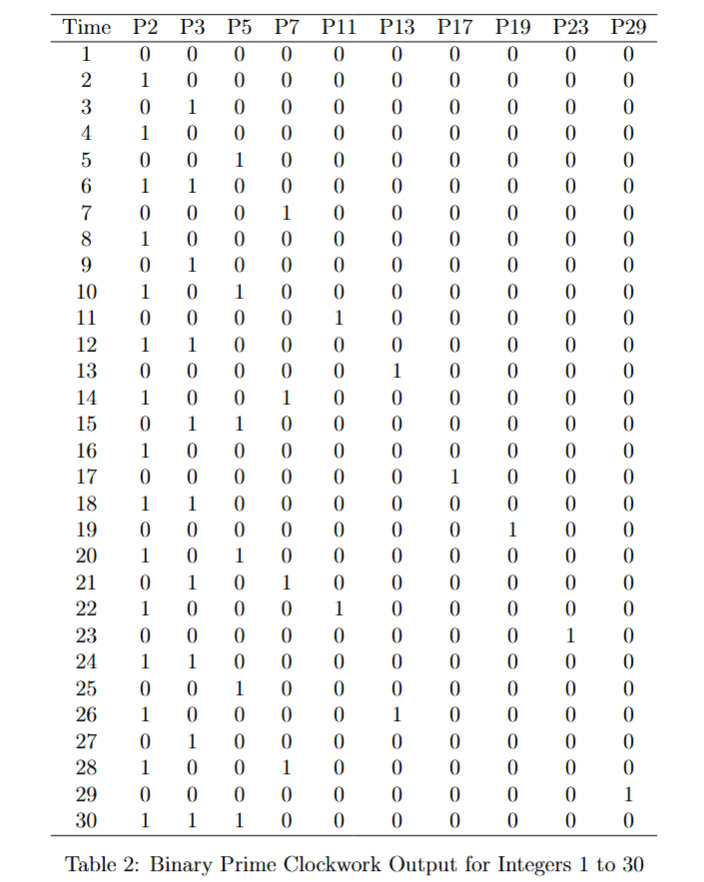
Definition 3 {Binary Prime Clockwork} Let us define a simplification of the output of the prime clockwork with outputs(prime factor exponents) as follows.
Similarly to prime vectors
, we refer to the result of these sequences as binary prime vectors, which we represent by
.

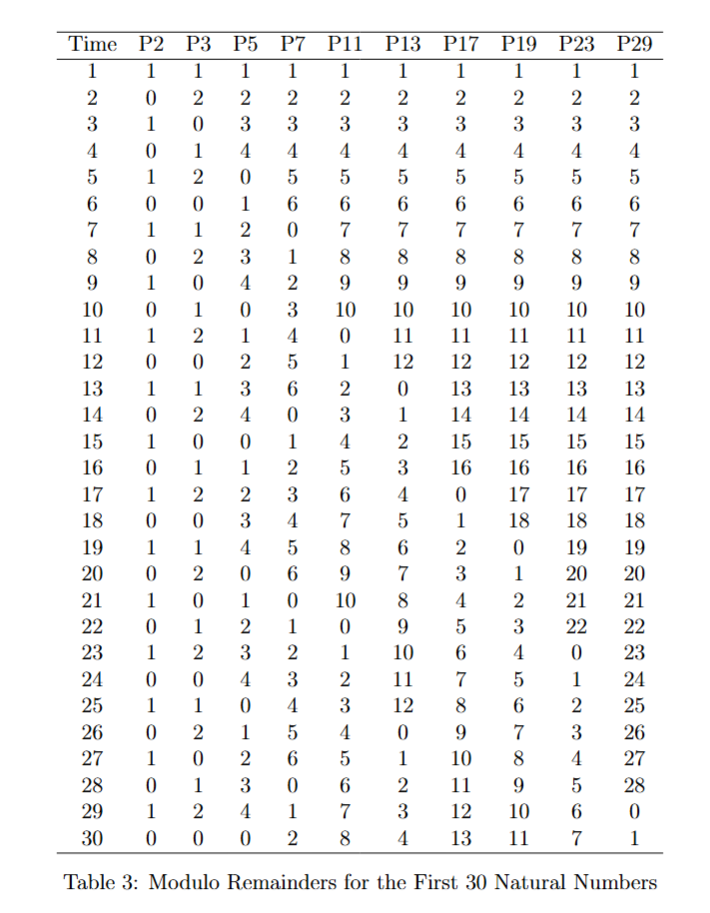
Please see an example of the (binary) prime clockwork output for the integers from 1 to 30 in the Table 1 and Table 2 (for the binary clockwork). The modulo remainders for the primes defining the columns are listed in Table 3, and we will discuss them later on.
Remark 1 The sequence ofcould be simulated correctly without computing
Remark 2 This abstraction of the prime clockwork output serves two purposes:
- The appearance of new primes relies only on the presence of
s in the output, and consequently, the exponents in the prime factorizations may be of little importance for questions regarding the distribution of the primes.
- The sequences
Now, let us examine the characteristics and duration of the recurring sequences.
Lemma 1 Letbe a subset of natural numbers. Consider the rows of the prime clockwork table indexed by time
, denoted
, and let
represent the projection of
.
The sequence
, where
are the primes associated with the indices
. Specifically, for all
,
In other words, the sequence
iterations, starting from

Proof: The seconds counters 


Lemma 2 Within one complete cycle of lengthcovers all possible combinations of the form

Proof: Each prime clock 


An example can be seen in Table 3. For instance the subset of columns P2 P3 and P5 goes through all combinations of seconds counters (or 


Application: Upper Bound for the Density of Primes
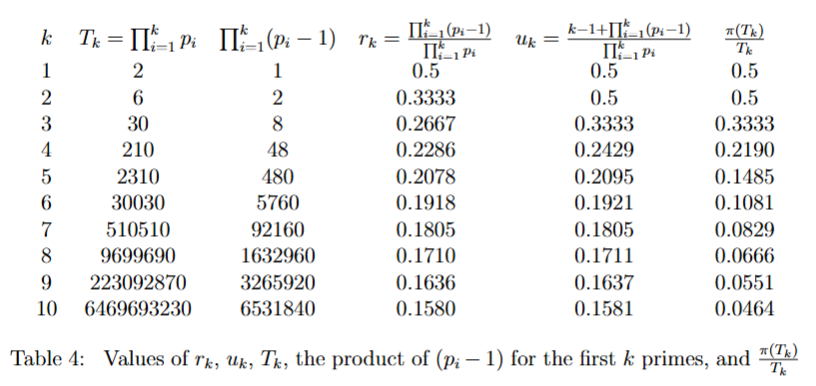
A simple application is the following upper bound for the density of primes by counting the number of coprimes to a given set of prime numbers and their combinations in a certain interval. Let 


- Total number of combinations:
- Number of combinations with no null values:
- Number of combinations with at least one null value:


At the end a simple lemma, that can be easily understood based on the moduli values of the clocks.
Lemma 3 Ifand
are coprime with each other, then their sum
is coprime to
Proof: The remainders (moduli, seconds hands) associated with the prime factors of
An upper bound for the primes and density of certain coprimes
Let 


Lemma 4 The number of primes in the interval fromto
and the ratio of prime numbers is at most:
.
Proof: If the prime number is among the first 


Let us remark that the bound exactly determines the number of coprimes to any of the composites formed of the first
Visualization of Primes as Complex Exponentials
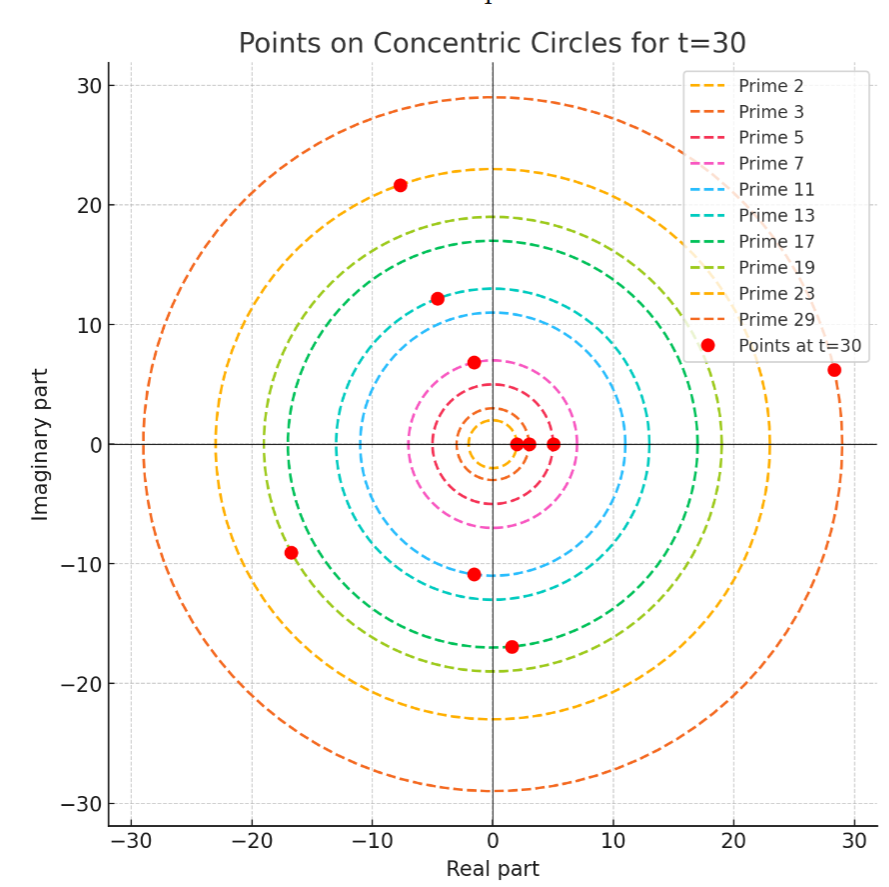
This section presents a visualization of prime numbers represented as points on concentric circles in the complex plane. Each circle’s radius is proportional to a prime number, and the points on the circles are given by the formula:

where 
In the provided plot (Figure 1), the first 10 prime numbers are used, with each prime 

Example:
Consider the example where

For each prime
This visualization highlights the rotational symmetry and the behavior of primes when represented as complex exponentials, offering an intuitive geometric interpretation of primes in the complex plane.
It can be observed that the points travel at the same speed on the circles.
Lemma 5 The pointson the circles travel at a uniform speed.
Proof: The circumference of a circle is 

From the theory of cycles in the prime clockwork the following lemma be easily observed
Lemma 6 Given an integerpositive zeros of the functions
are the prime factors of
Remark 3 The x-axis crossings of a prime clock with radius 1 can be used as an equation that needs to be satisfied when
Lemma 7 A numberis prime, if and only if
, and for the preceding primes
it holds
.
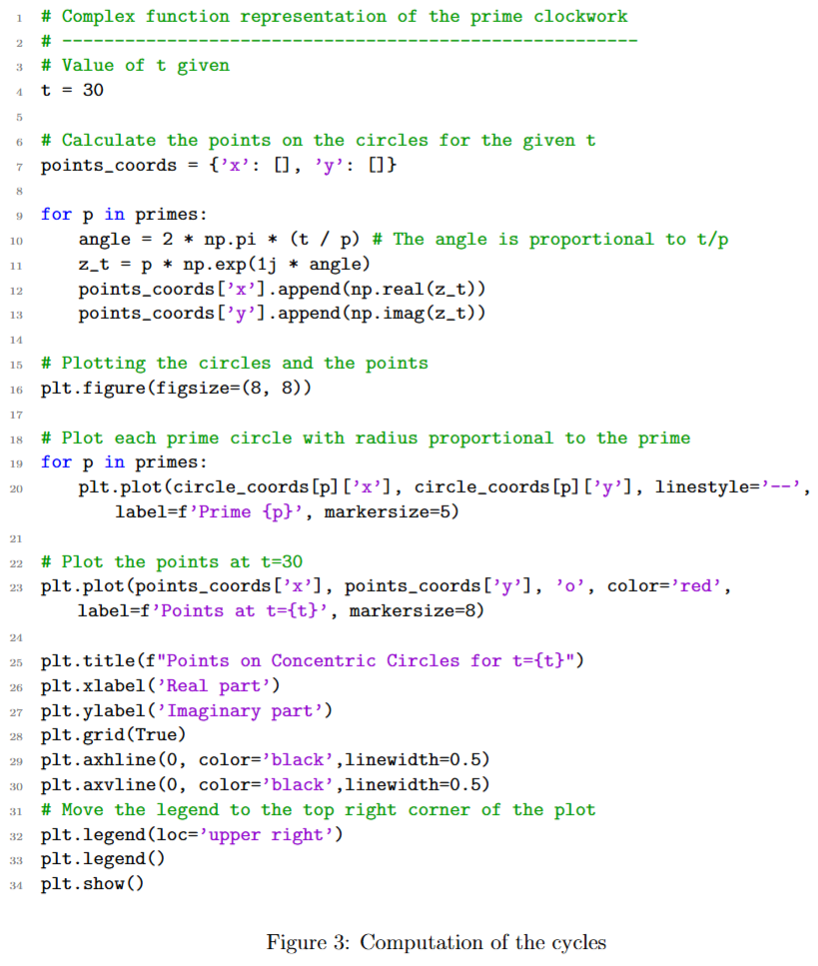
The visualization of integers using the modulus of prime numbers as positions on orbits around the origin offers an intuitive yet comprehensive representation of the prime clockwork. This echoes the earlier metaphor of gears and intertwined cogwheels introduced at the beginning of this essay. Even more captivating is witnessing these wheels in motion. To bring this concept to life, we’ve provided a graphical demonstration powered by a small Python program with interactive source code, available at the following link:
https://trinket.io/pygame/b4608620d3e0?showInstructions=true
The program that produced the static plot of the example we provided at the end of our essay. You can change the integer parameter t and get different configurations of the prime clockwork from which all moduli (prime) values and prime factors can be seen in a single view.
 Michael Emmerich